
It was only a few weeks ago; I sat across the desk from the editor of the newspaper I work for in a moderately dim office. I’m an intern-photojournalist for the “Gunnison Country Times” – the main newspaper of the Gunnison Valley in Colorado, and I have these weekly meetings with the editor (who I correspond with the most) to review previous assignments and to pick up new ones. Now, I’d say the majority of the assignments I’d received up to this point had been social functions of some sort – local sports games, social gatherings, assemblies the local university organized, fundraisers, etc., but this week was different.
The task sounded simple enough – capture some images of wild Bald Eagles, namely around a tiny “unincorporated community,” comprised more of river than structure, called Almont. I had two weeks at most to complete the task. Almont, for just about everybody except fishermen, is only a small, unimportant detail of a “town” North of Gunnison and South of Crested Butte. Fishermen on the other hand are treated to the conjuncture of two rivers, the Taylor River and the Gunnison River. That combined with the fact that there is a state fish hatchery, the “Roaring Judy Fish Hatchery,” a few miles North of Almont supposedly makes for some fantastic fishing. Funny enough, the factors that so frequently drive fishermen to this area are similar to the Bald Eagle’s (or Haliaeetus leucocephalus) motives.
My first attempt at capturing images of the large bird likely failed for several reasons. Mostly however, it failed because I had done no research about the Bald Eagle. For some reason, I was under the false impression that I would be looking for nests. You may remember from our previous entry, “Pinnacle-ada,” that before our adventure started, I had trekked around through the snowy “trails” in the fish hatchery’s property looking for Eagles. I must have done that unsuccessfully two or three more times before I wised up and contacted my ecology professor here at WSCU.
As it so happens, I should have never been looking for nests, as the Eagles that gather around Almont and the fish hatchery very likely do so for a communal winter roost. The Colorado Parks and Wildlife conservation coordinator suspects there to be as many as 100 Eagles that congregate around the hatchery for warmth and protection.
During my several first failed attempts, not only had my ecology professor spotted a few around Almont just driving around, but the other half of the Overcast Adventurers (Ty) had spotted an Eagle in another location relatively close by (Mill Creek) while lab assisting for a biology class. On the “wildlife sightings” communal board in the science building of WSCU, there were several Bald Eagle listings around Almont. With less than a week remaining until my deadline, I felt as if the Eagles were evil and plotting against me, allowing sightings for everyone but me despite my persistence.
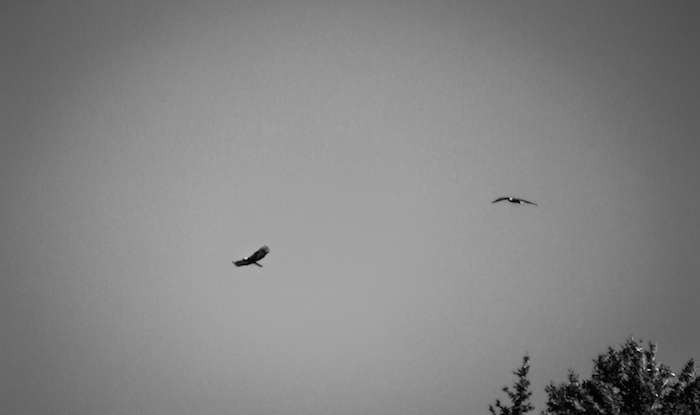
Skip forward a few days. I have two days to submit the photos. I go out to the same area and stick to my car, driving North and South back and forth. Right North of Roaring Judy, movement in the sky catches my eyes. I hit the emergency blinkers and pull over. Sure enough, a Bald Eagle and another large bird are high in the sky, flying around in no discernible direction. My camera and telephoto lens are at the ready – and within seconds I’m in full fledged photography mode; manual controls, manual focus…, but much to my dismay, the birds are way out of the reach of my already sub-par telephoto 300mm lens, and appear to be getting further away. As they vanish behind a ridge in the distance I curse my luck. I gave it another hour, driving around and eventually hiking around a bit, but no cigar.
My last day to be successful comes along. I get out of my ecology class at 3:15, head to my car, and start off towards Almont. I’m strangely optimistic given my two weeks of failure. I near the community, my car on cruise control, my mind balancing watching the highway and watching the trees by the river. I notice a nonconformity to the pattern of branches – a smooth shape in the trees. I follow it to the snow white capped head of the first Bald Eagle I had spotted.
I can’t describe the rush of the moment as so many things happen at once – there was no real pull-off area because of a guardrail on my side of the two-lane highway 135. My mind is a blur, I’m still driving, but know no one is behind me, so I grab my camera with one hand, steer with the other gently trying to hug the side of the guard rail while braking and hitting my emergency blinkers. In seconds I am outside my car, lens fully extended, trying to frame the Eagle just right, and still get a variety of shots. Maybe a minute passes as I try to slowly approach the bird, and then it takes off towards the South. I follow it with my eyesight and see a general area it lands maybe a fourth of a mile away, sprint back to my car, turn around on the highway, speed down to the general area, pull over again, and start scanning the trees. No dice. I wait about five minutes, using my camera and lens as binoculars, then see as it takes off from the camouflage of a shaded pine tree towards the North. I snap a few best as I can of the bird in flight, and then repeat the routine of sprinting back to my car to try to follow it. My luck has temporarily run out.

I drive North, back to the place I first saw the distant creatures. I spend some time walking around outside, then drive around a bit more, and decide to call it a day as I begin to head back to Gunnison.
Maybe halfway between Almont and Roaring Judy, I see another Eagle (I cannot verify visually if the two I saw were the same bird or not) perched on a low branch close to the river. The whole process I described early is repeated, and within seconds I am doing the wildlife photography dance outside my car.
What is comes down to with wildlife photography for me so far is the balance between technical ability, subject knowledge, and luck. With these shots, it sure would have been nicer to have had better telephoto glass with a longer focal length, but I try to not emphasize gear as being the crucial element of the equation (especially considering the images were still made). When I gained more knowledge of my subject using all the resources I had available; my ecology professor (who is also the ornithology professor here at WSCU), the internet, etc., and had spent a few weeks practicing my technical ability with bird photography, all I needed was a bit of luck to get the shot.

Story and photos by Skyler.

 The Overcast Adventurers