The writer half of the Overcast Adventurers finds himself working as a quartermaster for a summer camp this summer, so this entry is coming from just the photographer (and questionable writer) half. We miss you, Tyler. We’ll adventure soon.
How’d this all start? Last semester (way before the earthquakes), a friend of mine named Jenn started making a documentary detailing the culture of Nepal through the life of a Gunnison business owner named Pemba. More specifically, she was focusing on Sherpa culture; Pemba was born and raised in the Everest region, and grew up to eventually lead expeditions to the top of Everest (twice), Makalu, and other giant mountains. Pemba had moved to the United States and opened two amazing restaurants (both named “The Sherpa Café”) in the Gunnison valley, along with a small business that would lead trips and treks in Nepal called “Alpine Adventurers.” Jenn decided while initially making the documentary that she’d best be able to tell the story of Sherpa culture if she went to Nepal on one of the trips Pemba was leading this past May.
I primarily only knew Jenn from a co-curricular I take part in called Mountaineer Media, which she was the leader of. As a biology student, Mountaineer Media is a nice way for me to be active in the film community around campus, and work with people to make short films. At some point during the semester (still before the earthquakes) a spot on the trip Jenn was going on opened up, and as soon as I got word, I worked my butt off to try to get that seat. It made sense – we could have two students go to Nepal through Mountaineer Media to tell the story of Sherpa culture and Pemba, and I could act as somewhat of an assistant to Jenn.

It was after everything was basically certain about the trip that the first devastating 8.1 sized earthquake named the Gorkha earthquake ravaged Nepal, killing over 8000 people. I was in Denver the weekend it happened, and I remember waking up, reading an article about it in Aljazeera, and wondering what Jenn was thinking about the trip. Pemba had actually already gone to Nepal with his daughter to do some trekking around the Makalu area. We had no idea if Pemba was alive, and the folks at the Sherpa café (some of his family) had no way to contact him as communication in much of Nepal was cut entirely. I checked the Sherpa Café facebook page every day looking for updates on Pemba’s wellbeing. It must have taken about a week until they’d heard from him, alive and well. Now, as I watched the death toll rising every day, I wondered what was going to come of our trip. I suspected it’d be cancelled altogether. However, right before finals week, I got a voicemail from Pemba telling me everything was still set and that he’d see me in the Kathmandu airport on May 13th. I gave the news to Jenn and we started preparing.
Part One: Welcome to Crazy Kathmandu
Getting to Nepal was fairly straightforward. I took an airplane from Denver to New York at midnight, and the exhaustion set in quick. On the plane, I saw news playing showing Nepal and talking about an earthquake, and it took me a bit to realize they were talking about a whole new large aftershock that was reported, measuring 7.3 and killing a couple hundred more people. I facebook messaged Pemba immediately in New York, and he told me not worry.

I had a disgusting ten hour layover in the boring daydream that is JFK airport, then I got on a plane to Abu Dhabi. I described the twelve hour flight in my journal as “excruciating,” “very crammed,” and having at one point a “leaking ceiling.” I regrouped in Abu Dhabi where I had an hour to navigate through security and find my gate. The weather was a comfortable 110 degrees Fahrenheit. We took trams to the plane and boarded on an escalator. I prepared myself for arrival.

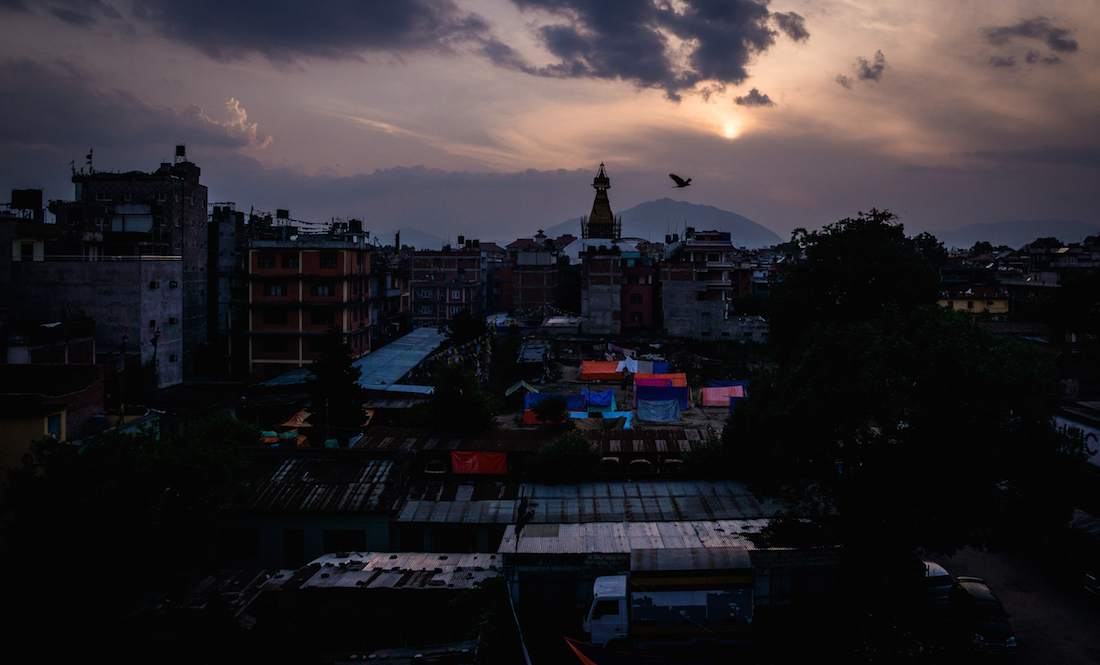
The sun set while we were high in the sky, and after a few hours a voice through an intercom told us we were preparing for descent. My eyes were glued out the window, unable to detect any shapes or figures until we started getting real close to the ground. I could see occasional electric lights, but I could also see fainter seemingly moving lights. Upon closer inspection I pegged them as small campfires, and I could eventually see tarps and tents around them. I wondered if I was going to be sleeping outside that night. We took a tram to the airport and I hastily struggled with figuring out customs, ending up being the last one there. After being rushed outside, Pemba quickly found me through a crowd and took me towards the street out. He quickly gave me a blessing, laying a khata around my neck and saying “Welcome to Crazy Kathmandu.” The adventure had started. We took a taxi through the dark streets of Kathmandu, and I watched as stray dogs ran rampant, and I could see many people sleeping under tarps around the streets. My glimpses of earthquake destruction were limited in the darkness. We arrived at our Kathmandu base of operations called “Green Hotel.” I ate some leftovers (it was pretty late at night), found my room, and passed out.
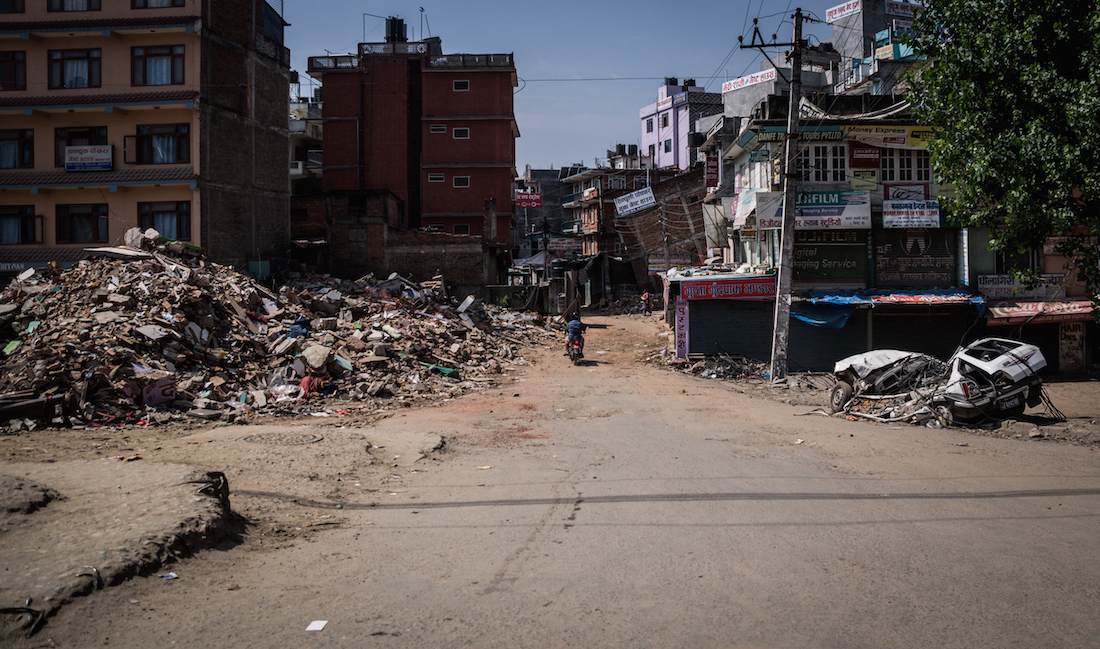
I awoke after an amazing night of sleep and met my roommate Mike for the trip. I took a shower for the first time in four days of travel then went outside to meet the crew. Our group had gone from eleven to five trekkers because of the earthquakes; there were not a lot of people to meet. Fortunately I had the great pleasure of very much liking everyone, and they will all be mentioned throughout the blog. To start the day we headed to the Monkey Temple. This was my first exposure to the driving around Kathmandu (and Nepal in general). I like to describe the roads in Nepal (from an American perspective) as sort of an open-cage death match super-free-for-all brawl to the death. From the outside there don’t really appear to be laws or rules, but the people of Nepal make it work. They use their horns more as bat styled echolocation rather than as an angry American thing. I also started being able to witness the destruction the earthquakes had wrought in parts of Kathmandu; where large buildings were slanted, or had collapsed entirely.
We started by walking around the entire Monkey Temple, a decent stroll, and then walked up as far as we could go to the top. The Temple however was closed due to earthquake damage.

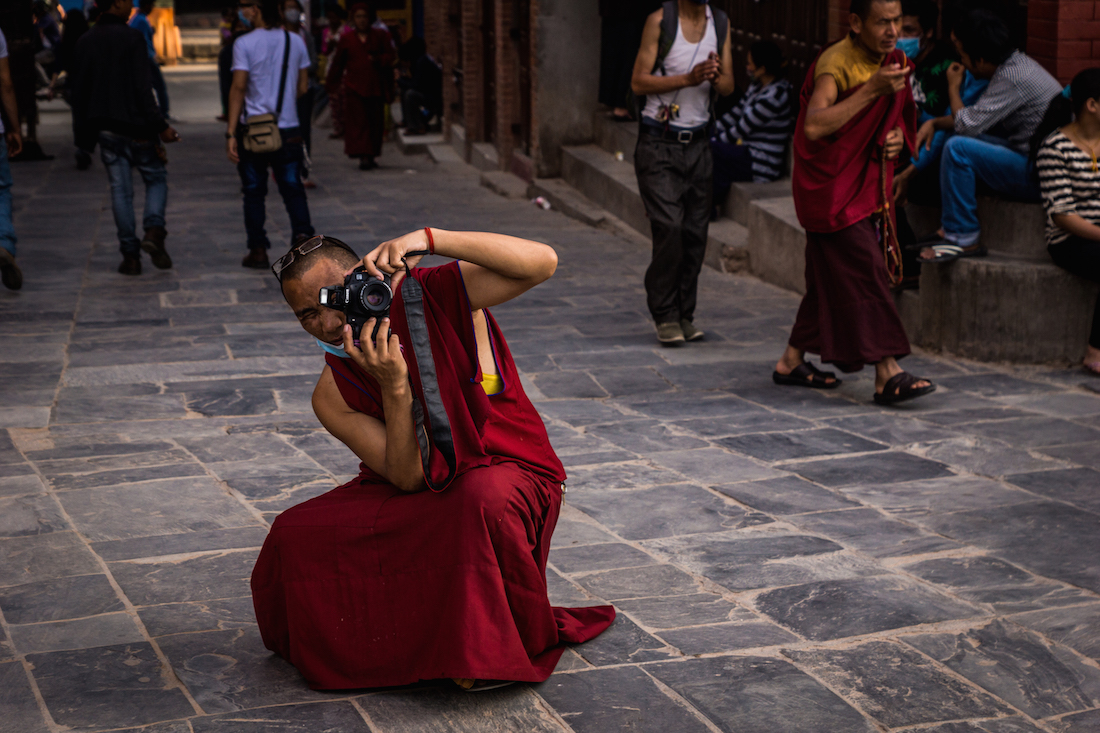
I also started to have the issue of not being able to distinguish where poverty would be without the earthquakes, and what poverty the earthquakes brought. Our next destination was the Boudhanath, or as we would call it, the “Boudha Stupa.” The Boudhanath is an ancient and massive stupa.

A stupa is sort of like a Buddhist temple; they’re mound-like structures containing Buddhist relics, and Buddhists use stupas for meditation and worship.

We walked around it three times, then ran into a group of people who thought it was crazy to see Americans in Nepal after the earthquakes, and took our picture.
Jenn wanted footage of one of the tent cities for her documentary, so we spent a good fifteen minutes walking to the nearest one from the hotel. At the tent city, we had a delightful glimpse of just how hospitable many of the people in Nepal are.

We met people who had their houses leveled by the earthquakes, and when they met us and found we were filming a documentary, they just wanted to show us the inside of their new living quarters, and they wanted us to meet their family, etc. It was beyond intriguing, and we actually drew a crowd in our visit to the tent city.

We finished the day with dinner in a “food-land” – a common ending phrase to names of restaurants in Kathmandu.
The following day we were up bright and early. This seems to be somewhat of a theme of the trip, however we were up early to catch a plane. With bags packed, we jammed into a van to go to the airport. Our next destination: Lukla (9,380 ft.). The security of the domestic flight terminal was interesting. I walked through a metal detector, which went off, and the guy just waved me through like, “whatever.” In our time at the airport I began to slowly gauge the fact that the flight to Lukla is notoriously scary. A woman named Sam from Melbourne we met at the (who was doing earthquake relief) described her flight to Lukla a few years prior as gut-wrenching and told of people crying on the descent. I had read before the trip that the Lukla airport was dubbed the “World’s Most Dangerous Airport.” Pemba was also talking it up to be pretty scary. After the whole rigmarole of going through the terminal, taking a tram to the small ~16 passenger plane, and having half of the flyers be seated, we were stopped.

We were all shuffled back to the terminal, and Pemba explained that the visibility in the Lukla airport was down to zero, and needed to be just about crystal clear for a safe landing. After waiting several hours, all flights to Lukla were cancelled, and we’d have to give it a go the following day.

The rest of the day was rather uneventful, however during a dinner consisting largely of fried rice, I was given the nickname “Big Boy” after eating several large portions (not all of them completely consensual.)
Part Two: A Big Boy in Khumbu
The following day, the same routine as the morning before transpired, and in the airport we were told there was once again zero visibility in Lukla. After an hour or so, an announcement in Nepali was made, and we were suddenly rushing towards the tram. We very hurriedly boarded the plane and took off. “Finally!”, we thought to ourselves. After maybe twenty minutes of moderate turbulence, we were out of crazy Kathmandu and out of the cloud of pollution that blankets it. Slowly, very large mountains became visible. With the pilots suddenly preparing themselves for landing, I figured it was time to descend to Lukla. I could see a runway and we were descending very quickly. With a little bit of lightheadedness, I rejoiced as we abruptly hit a runway and pulled off to the side. Sadly, though I didn’t realize it, we were not in Lukla. During the flight, you guessed it, the visibility in Lukla dropped to zero once again. We were in the remote airport of Phaplu (7,918 ft.).

We found a tea house called New Sherstha, drank milk-tea (this is such a common occurrence in the trip, you can almost assume that every other couple of sentences we do this), and interacted with the children around the tea house.
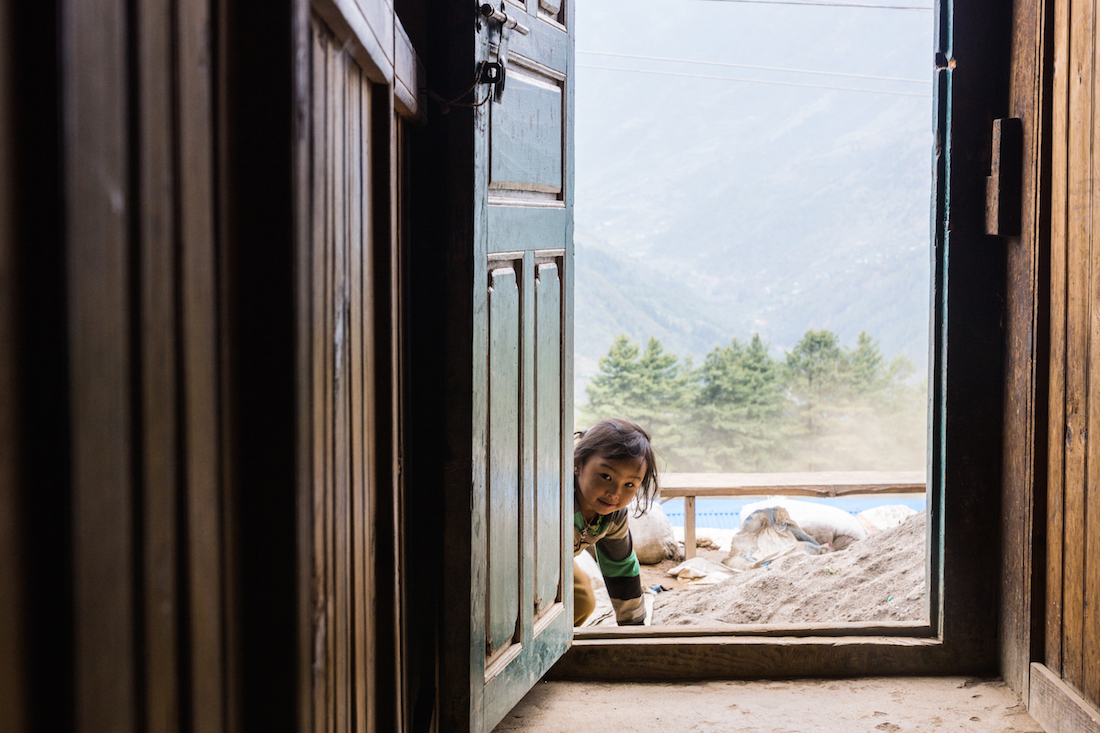
Talie, one of the trekkers of the group and one of the most traveled and interesting people I’ve ever met, learned the trick of carrying stickers around for children, which she handed out. The time came to hopefully make it to Lukla, and as we walked towards the runway, I heard the sound of a conch horn ring out. Pemba immediately knew what was going on and said, “someone died.” Immediately, I could see a funeral procession with several people carrying a stretcher with a body on it, and a small crowd behind. It was a pretty heavy moment for such little notice.

The flight from Phaplu to Lukla, all five minutes of it, was just fine. Sure, the runway was a bit on the sketchy side, what all with it being on top of the border of a cliff, and having a slight incline, but I honestly had thought the very sudden “emergency” Phaplu landing was more frightening.
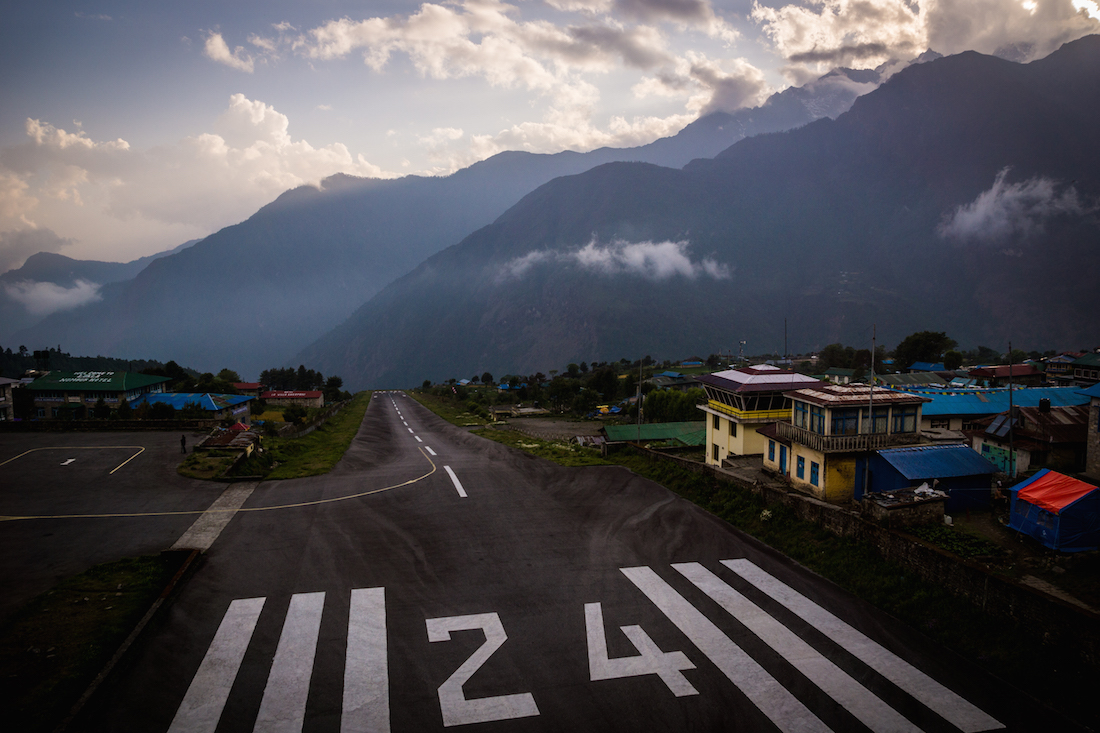
It was time to trek to Ghat, and time to become acquaintances with the Khumbu valley. We trekked through the rain and clouds, and all downhill, which we thought Pemba was joking when he said the trek to Ghat was downhill. I didn’t realize it at the time, but tremendous large mountains were visible from where we were, just not with the immense cloud cover the valley had rolling through.

I ended up trekking ahead of the group with Pemba’s daughter named “Neema” along with our two porters (one of which was actually a guide, but was sort of working as a porter for us) both named Mingma. A large number of the Sherpa people are named for the weekday that they’re born on, so these names are actually weekdays. Their middle names are somewhat more variable.
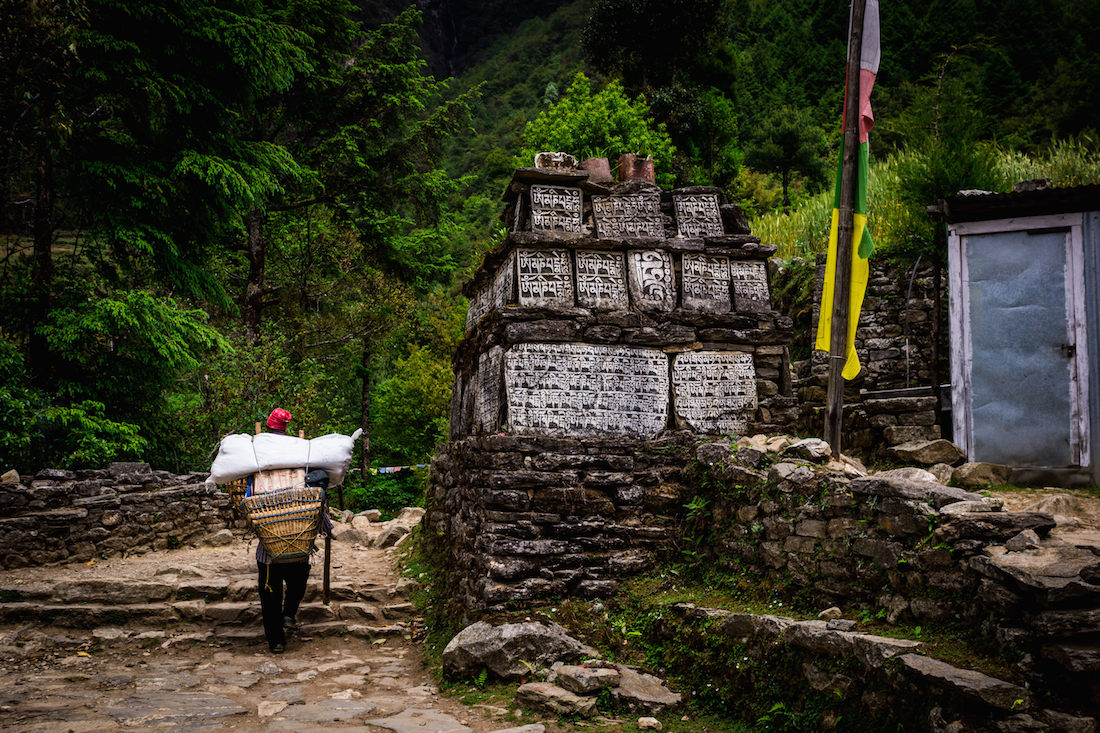
Hardly any lodges were open after earthquakes, and we actually decided to lodge in a homestay for our time in Ghat. This small village is actually where Pemba grew up, and later in the trip we visited the school he attended when he was younger. Typically, Pemba would have us stay in his house in Ghat, but his house was severely damaged by the earthquakes, and dangerous to be in or around. With some time to kill, Mike and I set out to explore up the trail a bit where we could see the stupa of Ghat. It was a wonderfully scenic stroll, and by the time we approached the stupa, a breathtaking peak that Pemba would later call “Phari” came into view (research on the internet also has it coined as Numbur Peak (I think)). We walked by ancient stones with Buddhist inscriptions carved in from ages long past.

The entire trip had stunned me to this point, but it wasn’t until we were admiring Phari that I actually had the sense of wonder and genuine awe wash over me. Closer to the stupa, Mike stopped me and put his hands out. Sure enough, the ground was lightly shaking and we were feeling an aftershock. Had Mike not pointed it out I might not have even noticed, but once I realized what was going on, it was somewhat scary – namely not knowing if the shaking was going to increase in strength. Once back at the homestay, we indulged in veggie chow mein, and were introduced to the locally made millet wine called Chhaang. I described the chhaang in my journal just as, “interesting.”
The following day, I arose early on my own accord to try to see Phari at sunrise. I did not, however, wake up to my alarm. Just about everyone in the house arose to a small aftershock. The day consisted of going to Pemba’s former house, and doing what we could to take it apart/prepare it for a controlled take down. The problem lay in that it was precariously built right by the main trail and posed a danger to people passing by. On the way, we encountered another large mountain called Kusum Kanguru (20,889 ft.), as we crossed suspension bridges and travelled by earthquake destruction.

We spent the morning moving tables and furniture out of the house along with a small group from the town. I do not exaggerate when I say that Pemba seemed to know everyone in the valley. Everywhere we went, flocks of people; his old friends, family members, etc., would gather to talk to him. We returned to the homestay for soup, potatoes, rice, and chai to prepare for the following day.
The following sunrise I wanted to check out Kusum Kanguru, so I sprinted the ten minutes over after waking up a bit late.
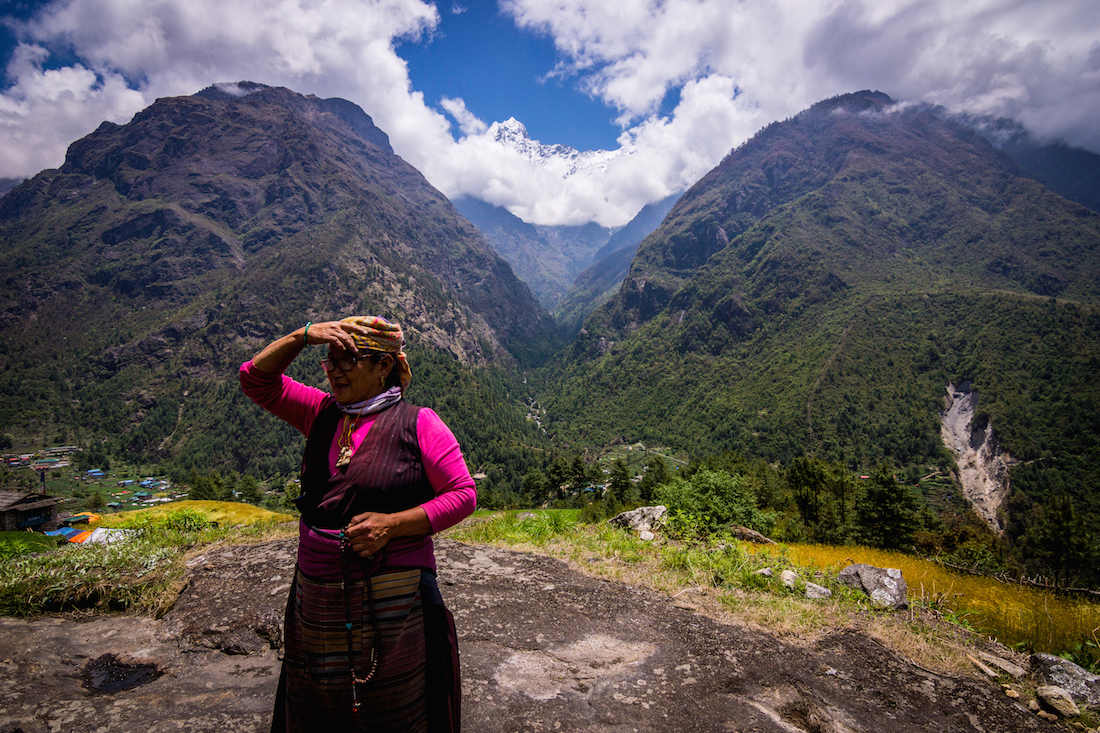
It was on this day we got to help out the community of Ghat largely thanks to the aforementioned trekker in our group named Talie. She was in Nepal during the first earthquake, trekking with Pemba near the Annapurna range. After the quakes, she raised money to get supplies out to the villages that weren’t really getting aid, much like Ghat. Some of the money she raised was used to buy tarps for the people who had their homes damaged, largely in part due to the upcoming monsoon season. We also had amazing help from the church of another wonderful person and trekker in the group, Cindy. (I’ll also mention that Jenn’s former band did a bunch of fundraising in Gunnison through live performance at the Sherpa Cafe – thanks guys!) This day consisted of us delivering the tarps to a smaller sub-community of Ghat that was actually cut off from the main trail thanks to a landslide caused by the earthquakes. We found ourselves practically bushwhacking the entire way up. It was on our way up we met up with a local who was in tears when she saw Pemba as she described to him how her house was completely destroyed. It was a powerfully sad moment for the entire group, especially with the language gap that kept the trekkers unsure as to what was going on. Pemba comforted her and we continued. We dispersed the tarps to the people of the sub-community, all while I took pictures of Talie with the people that got the tarps.
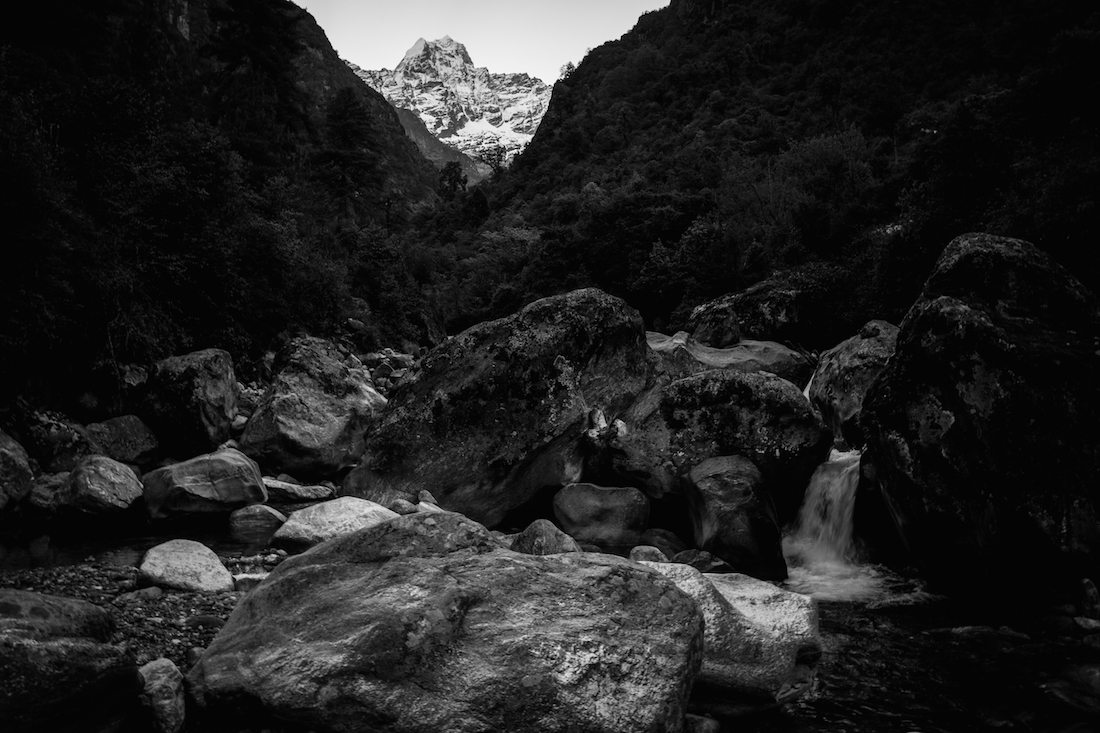
We also got to meet Pemba’s dad, and while they all conversed, we trekkers made our way down to a small waterfall where we relaxed a bit. The older Mingma showed us to a cool bridge by the area, and we headed back to prepare for the following day.

Our itinerary had us trekking from Ghat to a small town called Monjo (9301 ft.). We stopped in Phakding for breakfast. Ghat to Monjo was an easy trek, and we had a more elevated view of the damage that the earthquakes wrought as we delved further into the valley. A large problem for the Sherpa people here was the structural integrity of their houses. Stones were stacked without mortar on the outside of the wooden foundations of their homes. When the ground shook, and one stone became dislodged, the house essentially exhibited a Jenga like effect.

Once in Monjo, and after we checked into our lodge (Hotel Mini-Tibet), we walked to a school that was moderately destroyed, and I later walked up to the monastery, and above that, where an eerie destroyed structure that housed an old prayer wheel lay, surrounded by sun-washed prayer flags.
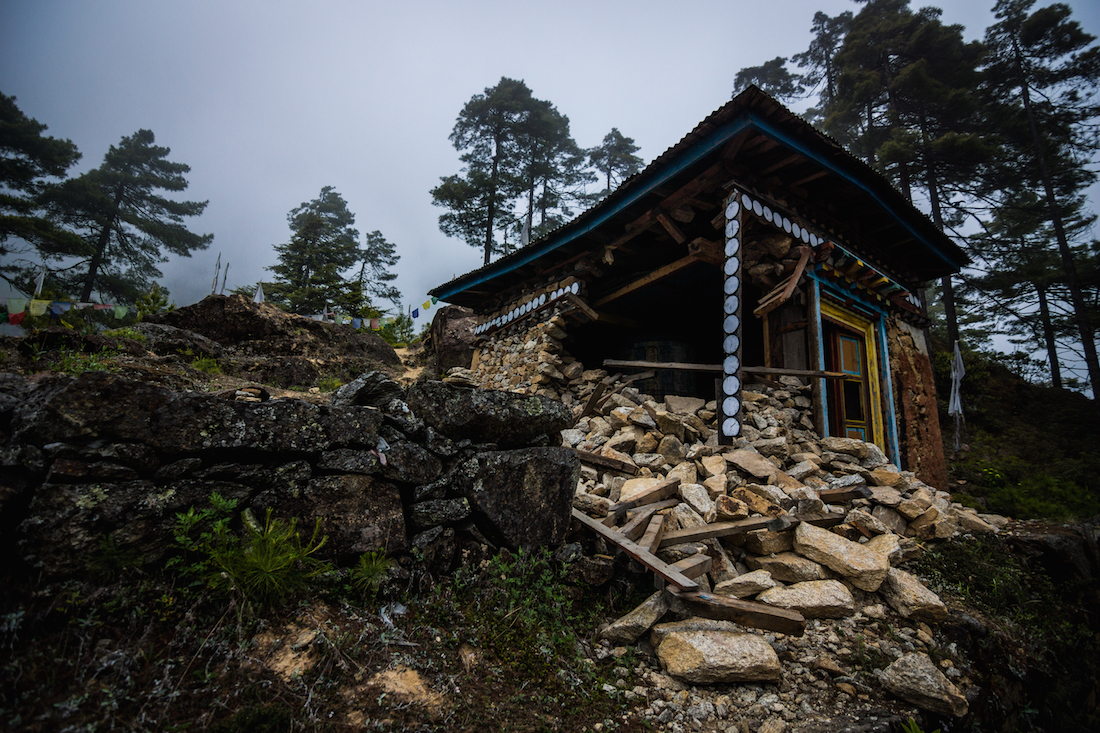
The overwhelming overcast nature of the afternoon added to the uncanny atmosphere of it all, and towards the top of the hill, I could see a waterfall across the valley.

On my return, I joined the rest splurging on traditional dal bhat (curry lentils, rice, and greens) by lantern light, and we rested for the day to follow.
As I found myself walking to the prayer wheel and monastery of Monjo early the following morning, I was attacked by a small dog, and I used my camera bag as a buffer for him to bite as he barked his head off and kept going for my shins. Sadly, it was too cloudy to see any real sunrise, and after breakfast, we left to trek to Namche (12,303 ft.). We passed though the gateway to Sagarmatha (Mt. Everest) National Park.

The initial portion of the trail was flat, but as we made our way up and crossed a high suspension bridge, we hit an uphill switchback heavy portion of the trail.

Additionally, it was raining by this time, and with a poncho on, I morphed into a walking, breathing sauna. Talie and I were the first up to Namche after a few hours of switchbacks, and we relaxed as an incredible view of a mountain called Thamserku (21,729 ft.) came into view. It had stopped raining, and it didn’t take too long for the rest of the group to catch up. We also spotted a Danphe on our way, which is the national bird of Nepal, and looks quite like a peacock. After we settled in at our lodge called “Hotel Norling,” I waked up to the Sagarmatha National Park Headquarters, which is theoretically supposed to be a viewpoint of Mt. Everest, however, Namche was completely covered in clouds to the point where I was walking through an unsettling thick fog.
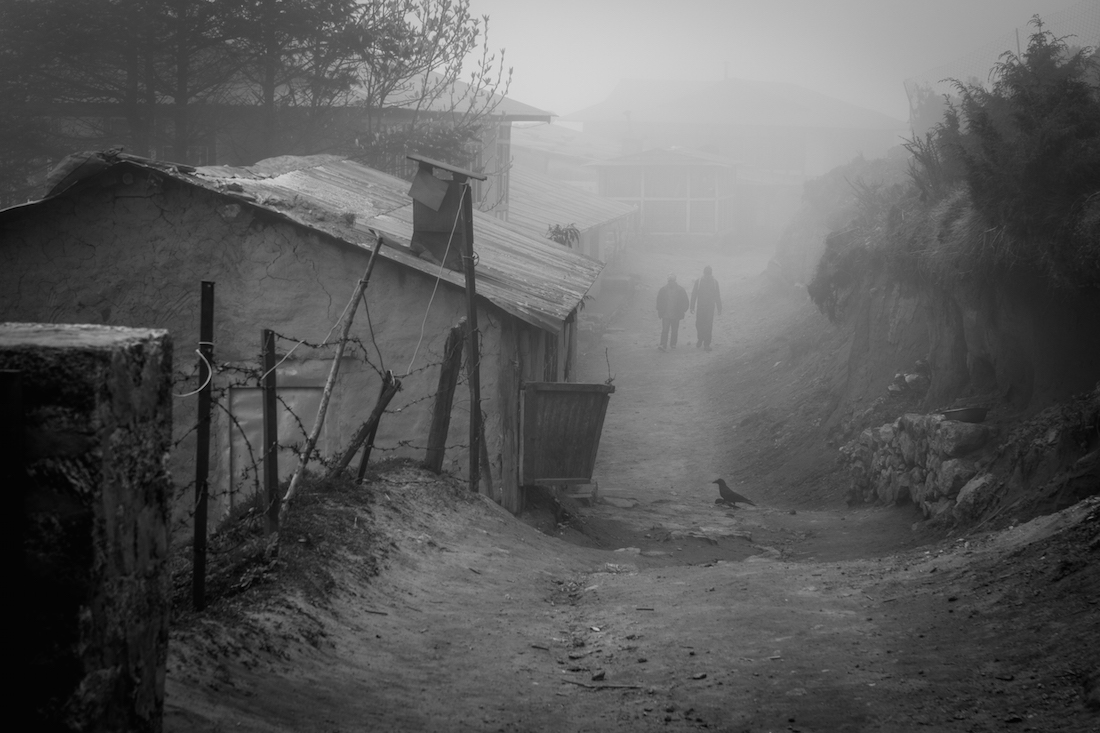
On my way back to the hotel, I met some crazy kids, and they seemed more than happy to be around a Westerner.
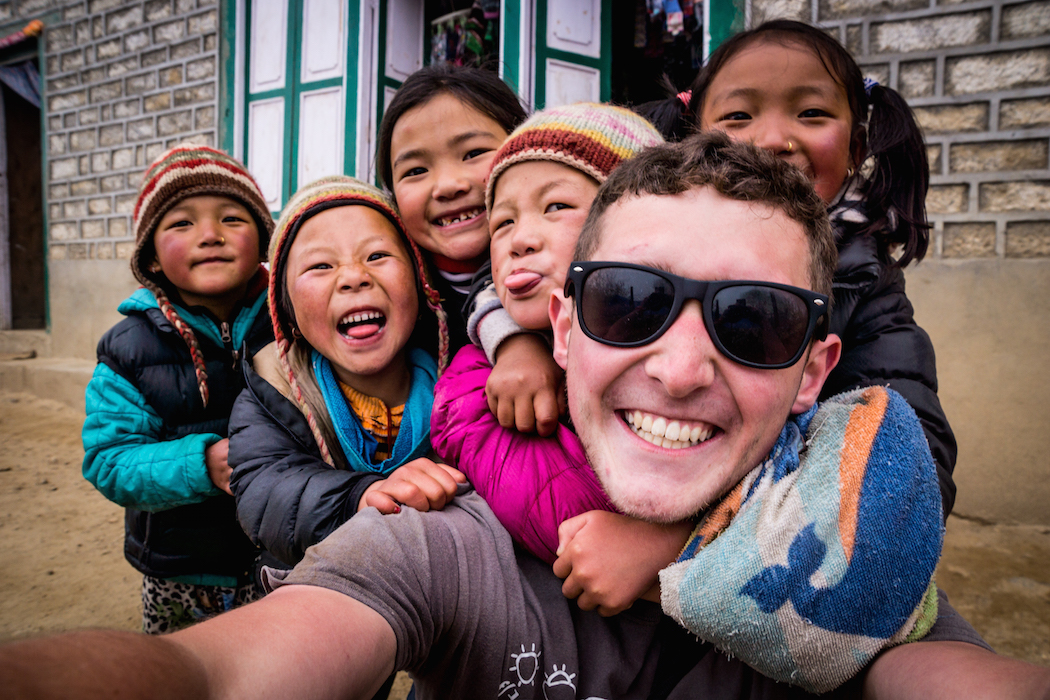
I didn’t realize it at the time, but in the three days total we would be in Namche (including on the way back), we would be the only tourists I’d see. Out of context this might sound normal, but the trekking route we were on is the primary route to get to Everest (and base camp). We were also there during the peak season for climbing, and Namche is a big gateway area for climbers to acclimatize, but we saw practically no one. Granted, base camp and Everest are closed, and will be for a while, but it was certainly strange being there.
Part Three: Magnificent Mountains and Magical Monasteries
On our following day in Namche for acclimatization, we woke up at 4:30AM to go to the Everest viewpoint, and despite the cloudy conditions that early, we still went just in case. Sure enough it was to no avail, but it was still cool being out there in those conditions.
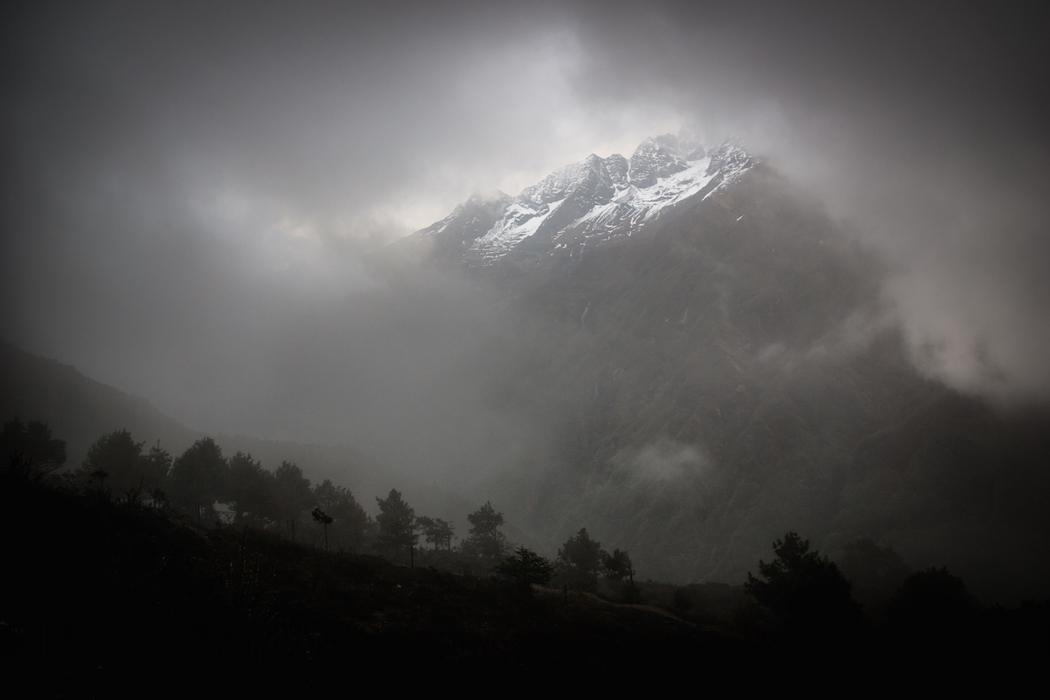
The clouds would blanket Namche for hours, then disperse entirely so that we could see Thamserku for a few minutes, then suddenly return. I spent the morning after breakfast hiking on the ridge around Namche. I passed cool stupas and some very large rocks with inscriptions.

I only ran into a handful of people, mostly who I just exchanged the “Namaste” greeting with. Upon my return, Jenn and I walked to the river to take pictures and meet with the people there.
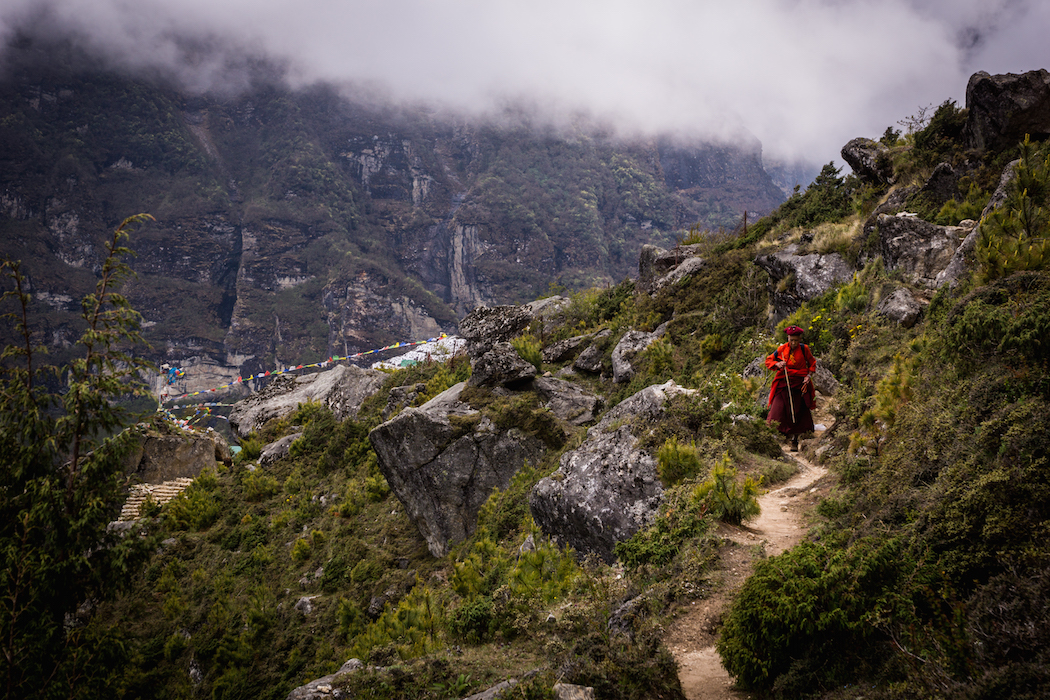
In Namche (and in lots of other parts of Nepal as well, but I’ll focus now on Namche), the earthquakes had made several buildings unsafe to be in, so people would sleep in the tarps and tents and whatever else they could set up outside. At the same time, there were lodges and houses that were safe to occupy with the significantly lowered danger of earthquakes, but people were simply too afraid to return in fear of more structure destroying tremors. A big part of the earthquake relief outside of physically supplying aid and shelter in Nepal will probably consist of psychological help to assist people with PTSD after the quakes. One of the people we met in Kathmandu was a psychologist doing just that for children in Kathmandu. I returned to the hotel and packed, preparing myself for times to come.
I didn’t bother with sunrise photos the following day. I finished packing when I woke up, ate breakfast with the group, and we set out to trek to Deboche (12,532 ft.). With it finally being a clear morning, we could see Kongde (20,299 ft.) towering over Namche to the West.
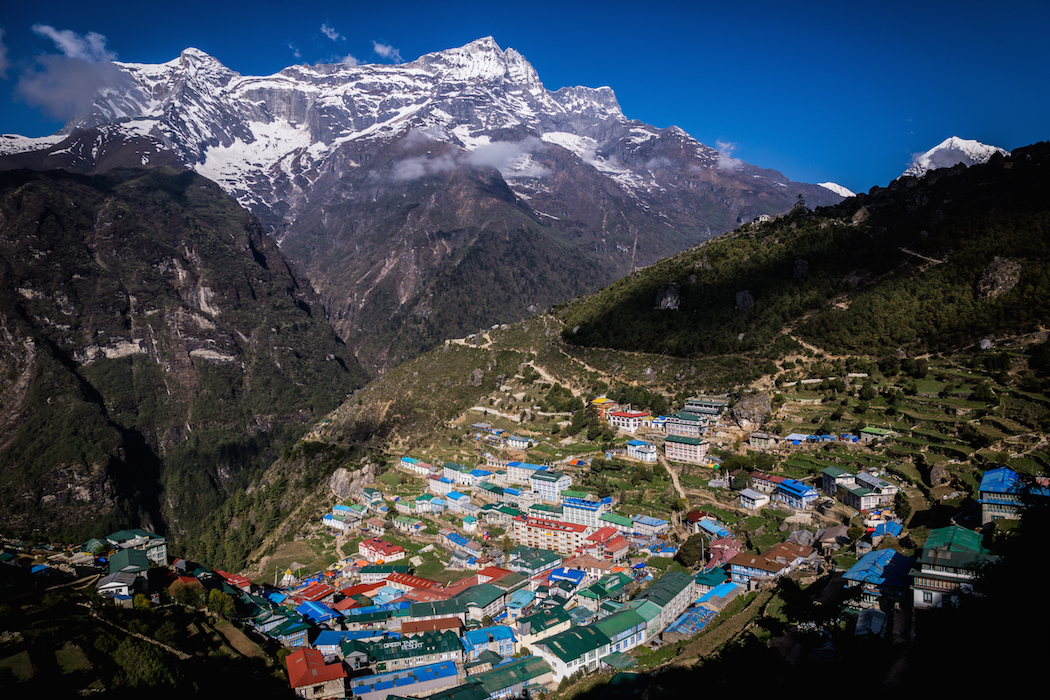
Down the trail a bit, a view of Everest (29,029 ft.), the mountain of mountains, loomed over us.

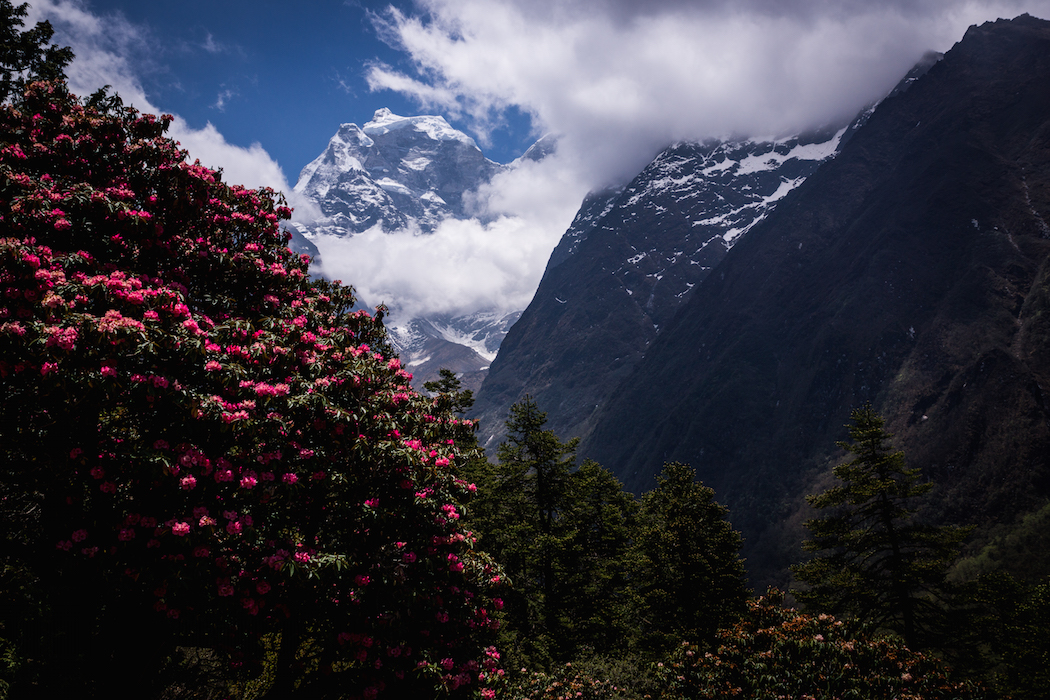
We could also see Lhotse (27,940 ft.) and Ama Dablam (22,349 ft.). The initial bit of the trail passed by large stupas, and outside of these giant visible mountains to the North, our old friend Thamserku was also wonderfully visible. The trail itself starts from Namche, then dips way down into the valley, only so that you can climb a decent number of switchbacks to get back up to Tengboche (12,687 ft.). On the way up, you have the pleasure of waking through Rhododendron forests with fantastic views of a large mountain called Kangtega (22,251 ft.), which means the “Snow Saddle.”
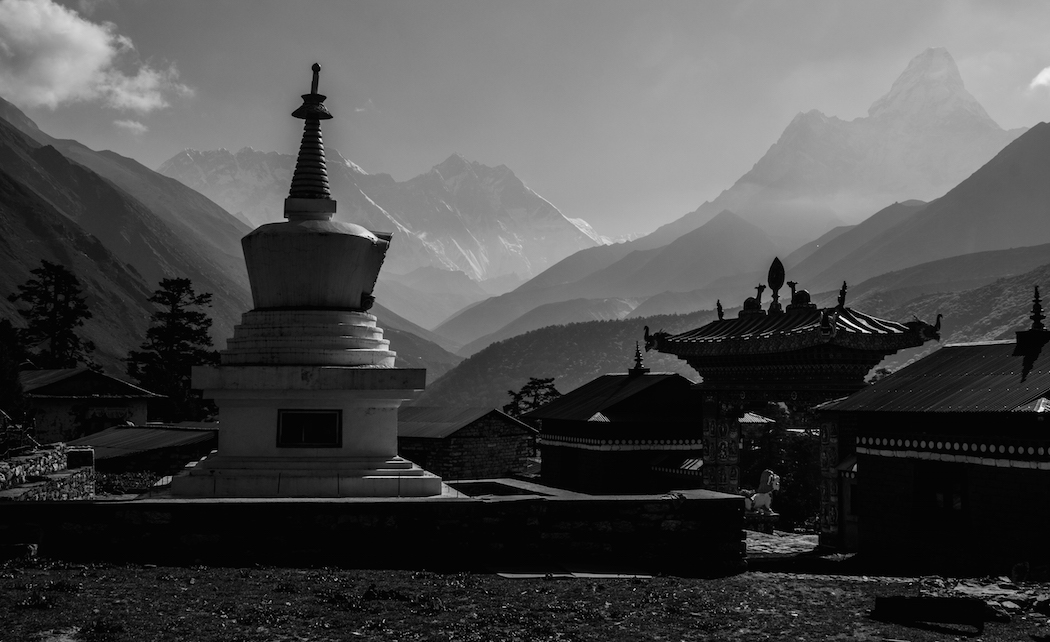
In Tengboche, we were greeted immediately by the most magnificent monastery we would lay eyes on during the trip.

Everest was again in our sights, and we took a nice break before continuing down the remaining ten minutes to Deboche. We stayed in a Lord of the Rings inspired lodge named “Rivendell Lodge.” We had a quick lunch. I left afterwards to hike up to a hill that I saw a stupa and prayer flags on right above Tengboche. It took me maybe forty minutes to make my way up to the area I had spotted, but by this time, I was already on a trail that went somewhere, and I had time to kill.

I followed the trail. It was a gradual incline at first, passing by three stupas before hitting an excessively sharp uphill grade. I told myself not to climb up for more than a few hours, and during my climb, the clouds danced their way around me. The entire trip felt like a Miyazaki film, but especially this moment, I felt like I was dancing my way through the wastes in Howl’s Moving Castle. I started to feel a little sick about an hour in, and I figured I should just go a little higher. Sure enough, I could see the silhouette of a stupa a bit higher than me, and I decided to make that my turnaround point. At the stupa, Thamserku was poking its head out of the clouds, watching over the valley.

Still feeling sick, I made my way back and spotted some Chilime (another species of bird) on my way down.

Back at the lodge with a map in hand, I discovered I had hiked up to 14,950 ft., higher than anywhere in the continental United States. With residual altitude sickness, I rejoiced as I forced myself to go to bed immediately after dinner.
I had slept like a rock. After I arose, I met up with everyone in the dining hall. The day was set to explore the inside of the Tengboche monastery, though due to earthquake damage, Pemba wasn’t positive we’d be able to get in. Luckily, as we made our way to Tengboche, we found that one of the monks of the monastery was related to Pemba and was able to let us in without any problem.

Though there was certainly destruction on the outside, there was no evidence of any earthquake taking place on the inside.
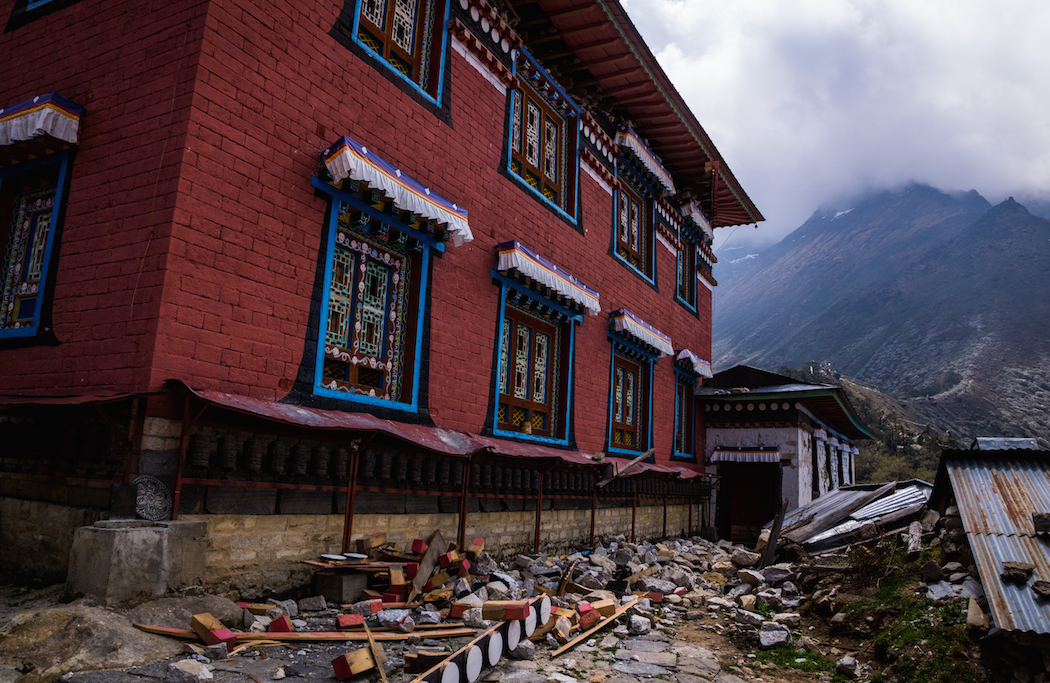
We removed our shoes and entered the main hall, where I saw the faithful locals immediately performing their religious ritual upon arriving to the sacred place. The inside of the monastery was magical – the colors were so vivid and the painting and layout of the entire hall was so enigmatic and intricate. The sophistication of the Tibetan Buddhist ways is just about unimaginable to me. We then went upstairs to an incredibly sacred room that was lined with shelves that housed ancient texts. Behind glass in this room lay Buddhist relics that looked otherworldly. We proceeded out of the monastery, through some of the destruction in the back to have chai. From here, Jenn, Mike and I took off to get up to the stupa I had found the day prior. Mike and I had hopes to get to the top of the giant hill next to the stupa, and though we tried for several hours, we could not find the route, though Pemba told us there was a way.
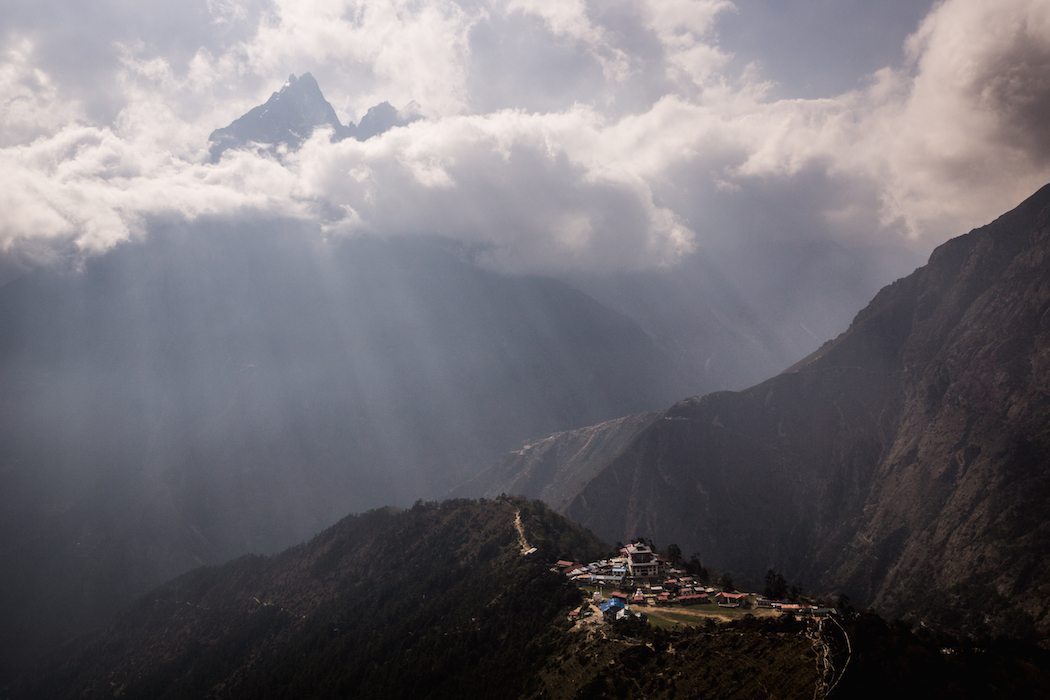
We still made it up to about 15,800 feet, a record high (for me) from the day prior. Once back down to the stupa with Jenn, we shared an Everest lager then made our way back.
Part Four: Right Back to the Start
We made our way back the following day from Deboche to Namche. The day was again surprisingly clear, and we had our fair chance to say goodbye to the mountains as they slowly left our view.
In Namche, I splurged on buying several maps of the surrounding areas.

For the first time, we had the chance to watch the sun set over Thamserku, and we enjoyed a meal of delicious momos. A funny part of Nepali/Tibetan culture (of this area) is how the serve food. Essentially, I think the trick is to tell the server that you’re full before you’re actually full because even if you say “no thank you” to more food, they are going to give you more food. The same goes for chhaang and chai. The server will say (phonetically) “shi shi shi shi shi shi” meaning “yes yes yes/please please,” as they try to shovel food on your plate, to which you have to respond (phonetically) “to-che to-che to-che to-che,” meaning “(no) thank you, thank you, thank you.” We’d often watch pseudo battles take place between servers/tea house owners and Pemba as they tried to give him more food or drink, to the point that he’d put his hands over his plate to block more food, or lifting his plate away from the table to hide it. As we ate the momos, nearly in silence in Namche, we heard the loud crack of the door being kicked in and the server woman running towards Pemba trying to give him more momos. It was like a sneaky ambush of momos. As I would discover later, this tradition carried true with alcohol as well.

The next day was a big day. We woke up to trek from Namche to Ghat, but instead of taking the main trail past Monjo, we’d go to the other side of the river and trek up a hill to visit Pemba’s old school. It was sad to say goodbye to Namche, but luckily for us, we had two stray happy mountain dogs decide to follow us to keep us safe. We named them Scrappy and Scruffy. Notably, thought-out the trek to this point we mainly only saw foot traffic, and I don’t know what made this day different, but we must have passed by six (or so) large herds of donkeys carrying various supplies up the trail towards Namche.

Once outside of Monjo, and splitting away from the main trail, we headed towards another sub-community of Ghat, where we were invited to share lunch in a refuge tent with some of the locals. The resiliency of these Nepali people is just so incredible – like mentioned before with the tent city; here was a family who was living under tarps who had invited us into their makeshift home to have lunch with them, cooked us a meal, and ate with us. I watched as they sort of fought Pemba as he tried to pay them money afterwards, but Pemba did prevail. The school was the next stop and it was extensively damaged by the earthquakes.

The ground was littered with stones around the structure, and the backside of the school, precariously placed by a steep cliff section, was crumbling down the cliff. It was weird to think Pemba had come here as a kid. We had brought school supplies (as we were instructed to do before the earthquakes), but school was obviously no longer in session.

We trekked our way back to the main area of Ghat, back to the homestay and relaxed. Udon noodles were served for dinner, and though I had only planned on having an Everest lager and a cup of chhaang, I ended up having several cups of chhaang poured for me. I thought though the day was eventful, it wasn’t quite pertinent for me to write anything in my journal until the following day due to my comfortable buzz, so deciding the night wouldn’t be too exciting, I crawled into bed and fell asleep.
KNOCK KNOCK KNOCK. CONFUSION! Mike got up to get the door as I was ripped back to consciousness and reality, still a little buzzed. Maybe only an hour or two had passed. Our friend Tshering was at the door telling us to get our stuff and get out. He was rushed and everything seemed to be in a panic. I had no idea what to grab, and I couldn’t remember where my shoes were, but he was instructing us to get out of the house as quickly as possible. I asked while pushing on flip-flops if another earthquake was happening (though I did not feel anything), and he responded, “The lake collapsed.” Having absolutely no idea what this meant, I frantically weighed my options as to what to grab. I could have grabbed my backpack, which had some hiking gear in it along with my passport and money, or I could have grabbed my daypack, which had some money in it and some photo-gear, but for whatever reason, my borderline dysfunctional brain had me grab only my camera bag and run outside. Everyone in Ghat was out on the main trail, evacuating to high ground as many locals were yelling back and forth in Nepali. Some people were in a dead sprint, carrying lanterns though the pitch black. We did not have the luxury of moon or starlight, as the overcast weather began to rain on us as we went to higher ground. Still very confused, and reasonably frightened, I asked someone else what “the lake collapsed” meant. Essentially, there is a giant lake by Island Peak called Imja Lake, which, if it were to collapse, would wash out a lot of the valley below. Some people higher up in the valley noticed a sudden increase in water flow in the Milk-Koshi River (the river that follows the main trail from beyond Lukla all the way up to near Everest), freaked out thinking that the earthquakes had triggered the collapse of the lake, and called everyone below to let them know that they thought Imja Lake had collapsed. At higher ground (but still watching other people continue to evacuate even higher), we waited, listening to the river. We could see people signaling using lights and something like Morse code from substantially far away. Pemba was on his phone almost this entire time, talking to anyone he could that might know what was going on. After maybe fifteen minutes, he said, “I don’t hear anything – I’m going back down to sleep.” We tentatively followed him, and tried to relax once again.
We learned the next day that a lake had collapsed, but it was a small glacial lake, and had practically no impact besides a bit of increased water flow in the Milk-Koshi River. We did on this morning have a bit of time to sleep in, thankfully, with the scare of the night prior. After a light breakfast, we made our way to the aforementioned landslide we had crossed to reach the sub community of Ghat. Our mission: build a usable trail across it with the help of some of the locals. The original plan was to have only a handful of locals helping us, but about thirty or so showed up. At the landslide, we got to work. The work consisted of initially moving large ass rocks (some taking up to seven people or more to move) off a horizontal section close to the trail, with the intent of then using them as a foundation for the trail.

We worked for a few hours in the sun, some of us moving rocks, some of us crafting the trail using shovels and other tools, all of us doing our best to help. We had an early lunch of potatoes and juice, then sure enough, the locals brought out some chhaang for the workers to enjoy.

I described the worksite as an “OSHA nightmare from hell.” Say what you want about unsafe working conditions, but it was the most efficient I had ever seen a trail be constructed, even with the difficulty of building it on a landslide.

After the work, we headed back to “freshen up,” and prepare for our trekking party. I enjoyed an Everest lager in preparation, and sat in the large dining room. Slowly, over thirty locals from Ghat showed up, dinner was served, and chhaang was poured. The traditional side of having more chhaang poured for me was elevated to the point where the owner of the homestay tilted my cup of chhaang as I raised it to my mouth to force feed me the alcohol. After several cups of the stuff, Rakshi, a much harder alcohol was brought out. In the phrasebook that Cindy, had brought described rakshi as “home distilled hard liquor – can be very rough.” It’s actually related to the production of the chhaang, but I’m not entirely sure how. The homeowner poured me a little over a shot of the stuff then just stopped and stared at me, waiting for me to drink. I threw it back, and she poured another, then moved on.

By this time, the locals had started to do their traditional dance, which consisted of loud singing, standing in a line, and somewhat of a choreographed step pattern. I danced with them, trying to learn the patterns as best I could. With nearly everyone drunk in the room, speakers were then hooked up and Nepali pop was played while everyone danced in a line. I did this for as long as I could, then knowing that I had to trek to Lukla the next day, purposely stopped myself, stumbled to my room, and fell asleep.
The morning was rough for many, but I felt great. After some porridge, we packed and said our goodbyes. Tears were shed by a few, and everyone was taking pictures of each other and having group photos be taken. Ghat to Lukla, despite being uphill, is a very easy trek, and even so, we stopped for tea a few times.
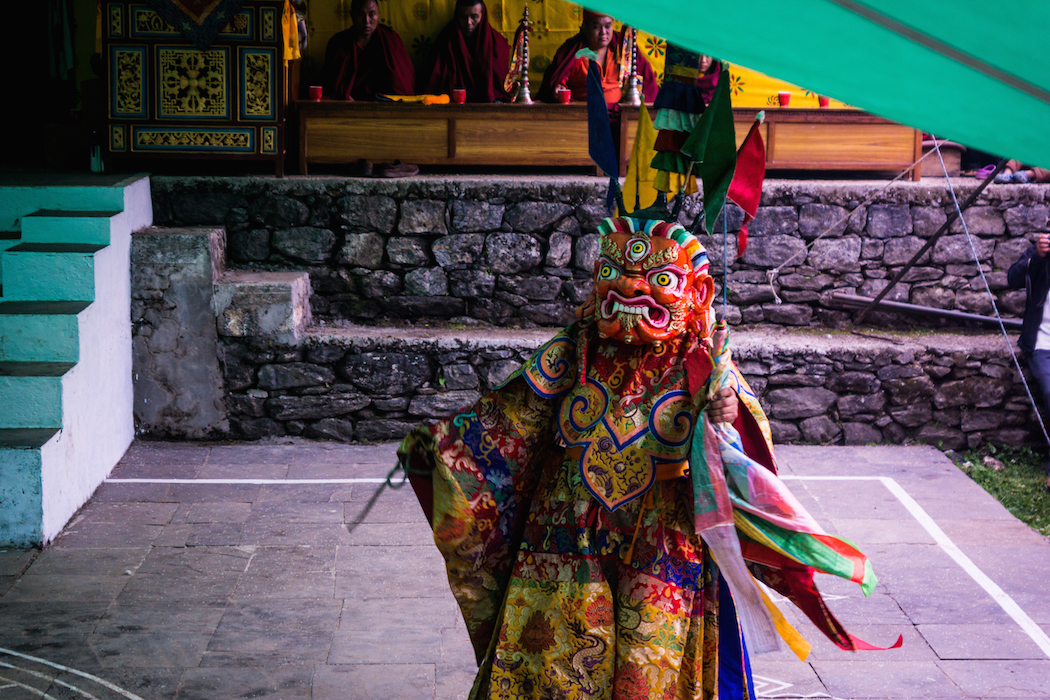
After dropping our bags off in our lodge in Lukla, we hit the town with several hours to kill. First, we hit a coffee shop, then Pemba got word that there was a festival going on at the monastery called Dumje. We headed over and watched the celebrations. Monks wearing masks performed all sorts of traditional dancing, and the crowd really seemed to enjoy it.
Upon our return to the lodge, we ordered dinner, and Jenn and I hit the only open pub in town, which the owners actually opened for us. Right after dinner, we tipped our porters for their incredible work throughout our journey.
I woke up early to walk around Lukla for the sunrise. I knew it was time to say goodbye (or at least a “see you later”) to the mountains.
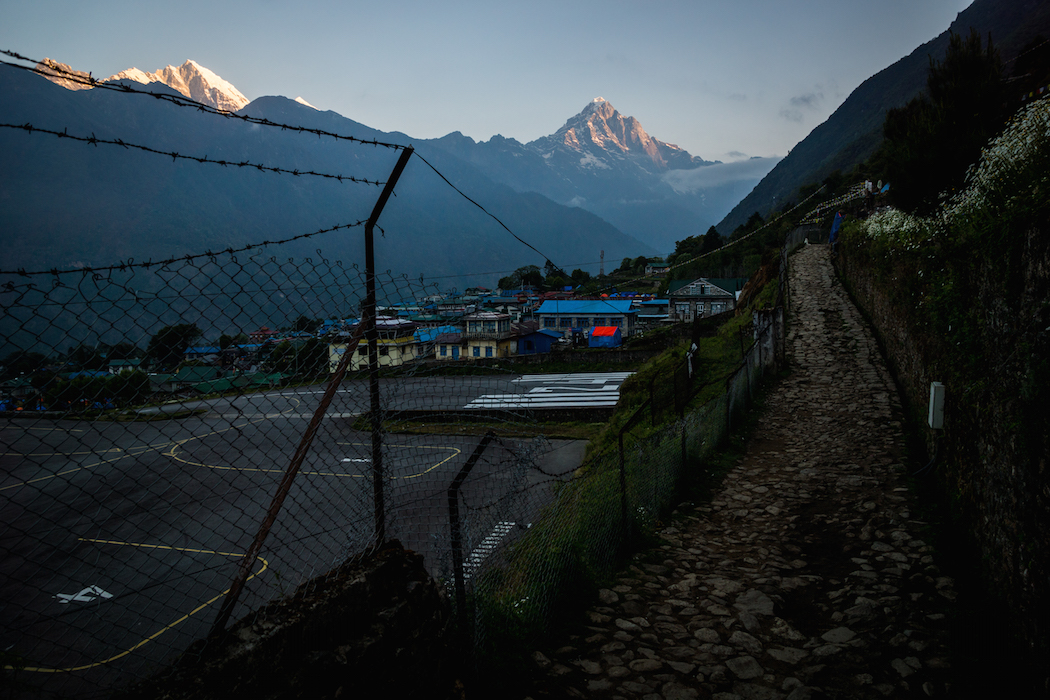
The morning was exceptionally clear. We shuttled our stuff to the airport and waited to board our plane.
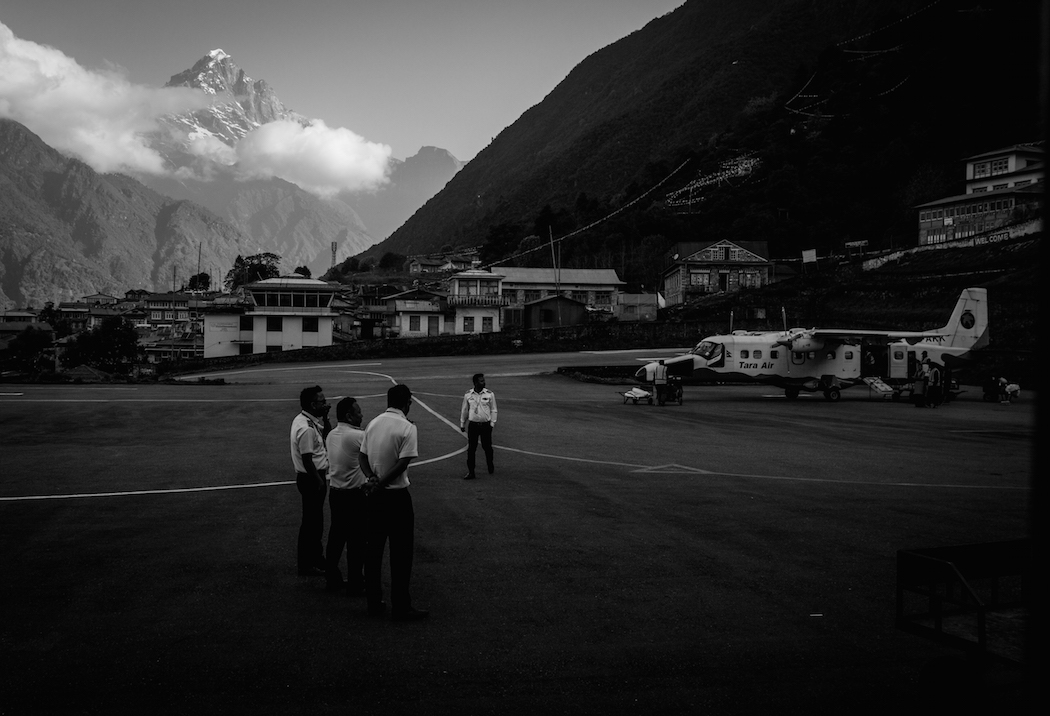
The flight back to Kathmandu was uneventful besides the occasional “oh shit” turbulence, but it was certainly smoother than the flight to Lukla. We had a free day in Kathmandu, and Jenn and I spent time interviewing some of the trekkers and Pemba for her documentary.
Part Five: Pokhara Partying and the Return
We left early in the morning to catch a bus from Kathmandu to Pokhara. I thought I was used to the driving in Nepal at this point, but I hadn’t take a bus down the highways yet. Essentially, imagine a one and a half lane highway that hundreds of tour buses share going back and forth, and imagine that for much of the journey, you are driving by a ledge. Outside of this, if you have the displeasure of being able to see out the front window, it constantly looks like buses are hurdling right towards you, only to swerve around you at the last possible second. We stopped for rushed meals throughout the ~7 hour ride, and we met an interesting Frenchman named Eric on the way. In Pokhara, the heat hit immediately. It was absolutely humid and exceedingly hot. Off the bus, a very aggressive businessman swayed Pemba to come and check out his hotel for our stay. We took taxis over and decided to stay. After a little bit, we headed off for dinner. Neema knew of a place that had top notch naan that I later described in my journal as “bitching.” Along with the food I treated myself to a few mojitos, and as we ate and drank, an immense amount of rain was released from the sky. It flooded the streets and was even washing its way into the restaurant. As the rain subsided and we left, Jenn, Mike, and I decided to go bar hopping. In this excursion, we learned the hard way that a “dancing bar” meant strip club – sadly NOT a place where you could dance as well. We ended up in a joint called the Busy Bee Café, where we spent some time dancing to live music (along with ordering a drink called “The Long Trek”), then called it a night and headed back.
The day prior we didn’t have much time to actually explore the wonders of Pokhara, like Phewa Lake, or views of the Annapurna range. For this reason, we decided to wake up at 4:15 to drive to a viewpoint of the Annapurna range for sunrise. Sadly, clouds obscured the range, though the sun would occasionally poke its nose out.
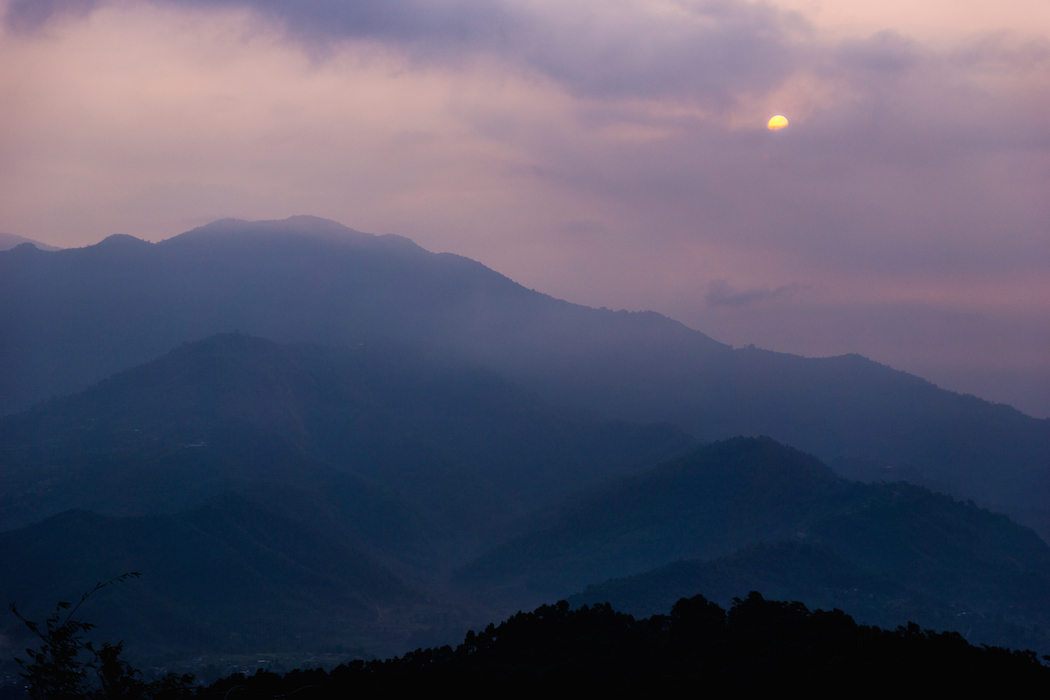
From here, we returned to the hotel, and prepared for a boat ride of Phewa Lake. On the lake, we paddled to a small island that housed a Hindu temple called the Barahi Temple.
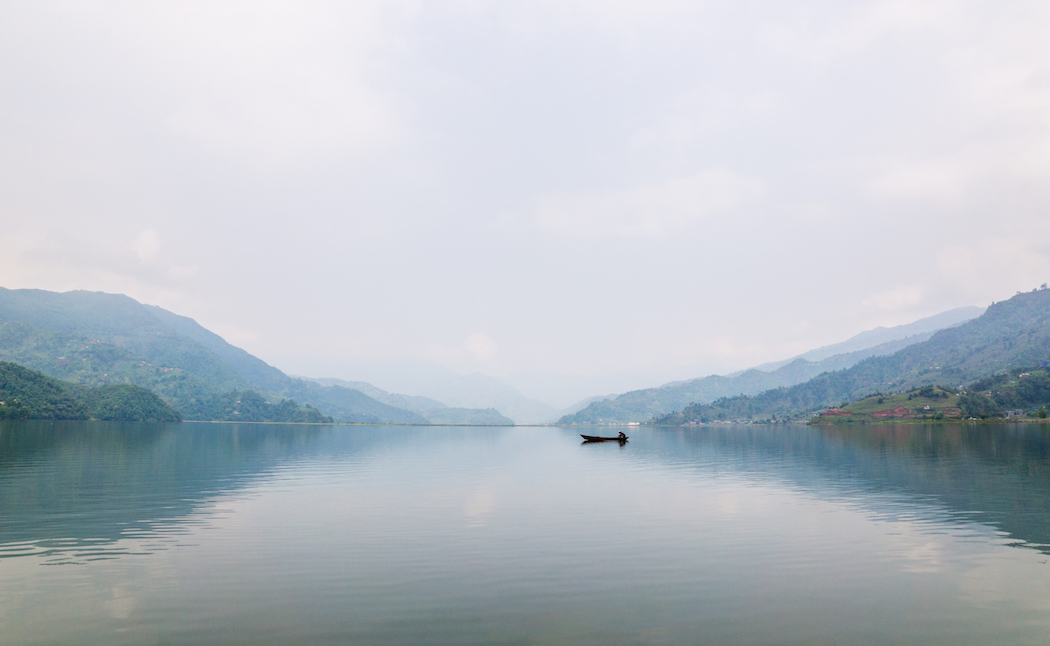
The day was special for the Hindu people as they were celebrating their ancestors. On the island, I had noticed a few goats wandering around, which I didn’t realize were for sacrifice until I saw the aftermath of one being carried out of the small enclosure where they perform that. In my surprise, I must have looked horrified when I saw this as one of the men carrying the goat’s carcass yelled “IT’S FOR GOD,” at me. Very startling, indeed. I have pictures, but they may not comply with wordpress terms and conditions due to graphic nature.
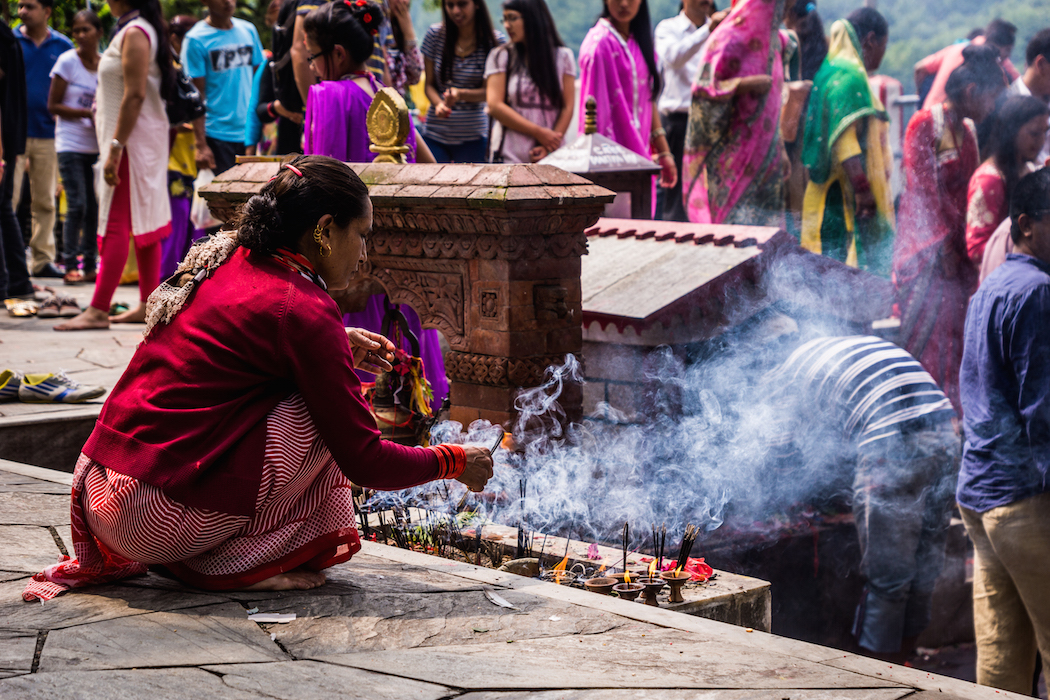
We headed back for an afternoon of relaxing and exploring the many cool shops around our hotel. We tried to head over to a concert before dinner, but we arrived just as it ended. Mike drew a huge crowd spinning a staff of bamboo he’d found, and the people there thought it was so cool that they were taking selfies with him after he stopped. With everyone in a good mood, we had dinner, and Jenn and I headed over to the bar of the restaurant where we ate lunch. Mike met us there and we headed to another place where I left them to interact with the crowd there to check out another bar that I had noticed close to the concert area. The night almost seemed to just slip away as I headed back to the hotel to rest.
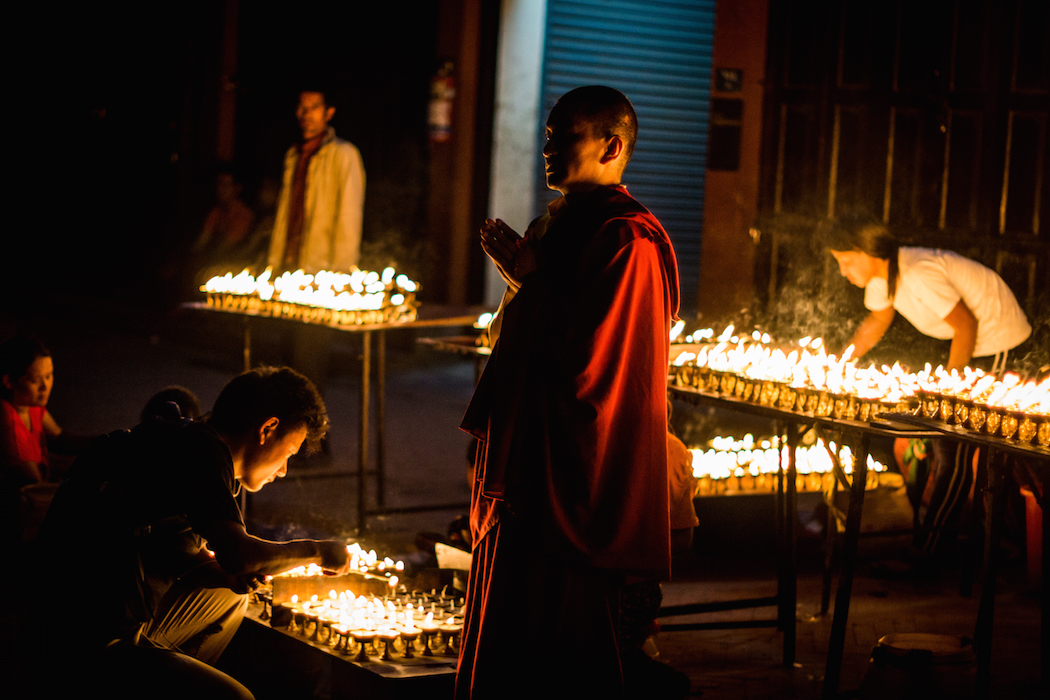
We bussed back to Kathmandu the next day, and on our way, we got stuck in a traffic jam that lasted for about an hour. The highway infrastructure could maybe use a bit of improvement. Back in Kathmandu, we took a taxi to our hotel then spent the evening exploring around the Boudha Stupa. We were lucky, like with the Dumje festival in Lukla, to be around the stupa this particular time as a special time for Buddhists was taking place called Saka Dawa. Many would stay up all night the night of the full moon to celebrate and for worship. Also with this, I got to witness people circling the large stupa in an interesting manner: taking three steps, then laying on their stomachs, then standing doing some arm motion, and repeating. It took these people quite a bit of time to go around the stupa in this fasion. I spent time after dinner trying to document this phenomenon.

Loud music woke me up the following day, likely related to Saka Dawa. As we ate breakfast, we decided it’d be good to go to Durbar Square, an iconic area of Kathmandu that endured quite a bit of destruction in the earthquakes. Once we arrived after a long taxi ride, another surprised Nepali man made conversation with our group telling us it must have been really brave to come to Nepal so soon after the earthquakes. This reminded us of a nun in Lukla who had begged us not to continue down the trail, fearing for our safety. Everything did work out for the best. Durbar Square was mostly closed due to the unsafe structures, but it was fascinating to see the delicate intricacy of the buildings, parts carved from wood, that were still standing. Many of the buildings that were still standing were held in place by large wooden support beams.
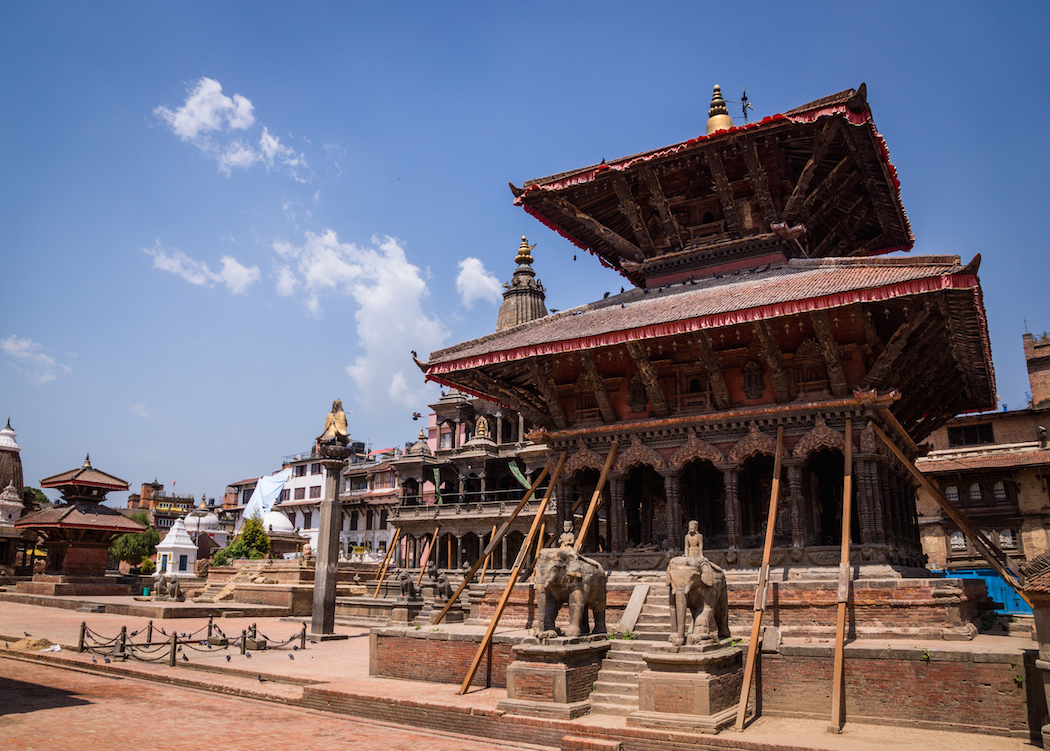
We stopped for pizza on the way back, as well as some souvenir shopping. On our way back to the hotel, we stopped in a well hidden shop where they sold authentic prayer flags and other Buddhist paraphernalia. What made this stuff authentic was the fact that a monk lived in the shop and actually hand inked the stuff like the prayer flags – they weren’t just mass-produced like most of the stuff available to tourists. After a nap in our hotel, we headed to dinner in another hotel.

I splurged on delicious momos once again, and as we ate, Jenn said she was feeling like she might be having an allergic reaction. She asked the staff if her meal had cashews (her allergen) in it, but they said no. As the group decided to go to the stupa to watch Saka Dawa celebrations, I agreed to go to the hotel with Jenn to get her some Zyrtec. At the hotel, Jenn was doing worse, so I ran to find the group (mainly Pemba). When I found them, Talie told me Pemba was back at the hotel, and I told her Jenn was getting worse. As they ran back to help her, I stayed at the stupa thinking she’d be fine with everyone there. I did some long exposures of people walking by with the full moon visible in the sky behind the stupa, then made conversation with a stranger for a while.

I returned, found Mike and Cindy, and asked if Jenn was alright. While I was gone, apparently Jenn had gone into anaphylactic shock, and Talie and Pemba took her to the hospital. I asked the hotel staff where the hospital was, and they drew a map for me. It was literally thirty steps away. I ran over, saw Jenn was alright (though hooked up to an IV and purple), then returned to let Mike and Cindy know she was fine. All was ok again, and I hit the hay.
It was time to leave Nepal the following day. It was really a lazy day because our flights were at night. We had all day to pack, and Jenn (now not purple) and I took time to do some final interviews. In my journal, I wrote the following, “A lazy, easy, sad day. Packing. Interviewing. Lazing.” Pemba shuttled us to the airport, and we all slowly found our planes, boarded and left. Jenn, Mike, and Cindy had the same flight to Doha, and Talie and I had separate flights. I went through Abu Dhabi again, but after a nine hour layover in the mall that is the airport there, I flew to LAX, where I had a few hours to kill thanks to delays, then flew home. In my journal, I eloquently noted the plane ride(s) as “Kids crying. Boredom. Delays. Pain.” It was sad to leave Nepal, but I was excited for the process of looking over the immense amount of media I had taken for the documentary and my photography.
As if over 8000 words couldn’t describe up until this point, Nepal was a completely different and eye opening experience. Being there after the tragic earthquakes only added to this wild adventure. I cannot thank my group, Pemba (the pony driver), and everyone who helped me get to Nepal enough. This being said, while we were in Monjo, Pemba and I struck up conversation about easy 6,000 meter peaks, and he said he’d done Mera Peak countless times. With this notion in the air, we tentatively planned a trip to summit Mera in 2017. Nepal is one of those countries you can’t go to just once. With the people just about as superb as the landscape (and exceptional food, of course), it was hard to leave, and I can only just dream (and fangirl) about the time I go back. Until our next entry, please friends, stay adventurous.

 The Overcast Adventurers