Limestone is a soft rock made up of calcium carbonate. Water, which is regularly acidic after interacting with carbon dioxide, eats through limestone easily, and creates many of the world’s most awe-inspiring caverns. There is precious little of this rock in Colorado, but some exists in the north-western part of the state where a few caves have formed over the eons. These caves are not well marked and lie far off the beaten path. Skyler heard tell of one of these caves from a family friend, and we immediately added it to our list.
Spring Cave, our destination, lies in White River National Forest, some distance southwest of the town of Meeker. Skyler had to contact the local ranger station and fill out a permit in order for us to go spelunking there. Bat populations across the United States and Canada are being decimated by White Nose Syndrome, the result of a fungal infection. The Forest Service would like to prevent the infection from spreading to Colorado. Hence, the permit, which included an agreement to follow decontamination procedures for our gear. This process was simple and easy to follow.
Information on our destination was scant. Little more than anecdotal accounts exist online, which was unfortunate considering our past experiences with doing too little research. We still did our best to pack accordingly, bringing warm clothing, helmets, headlamps, and a whole slew of spare batteries.
We departed Denver on a Tuesday night, and followed I-70 West past Glenwood Springs. It so happens that there’s very little public land in this area, so Skyler and I wound up sleeping the night away behind a transformer box in a supermarket parking lot in New Castle. Adventure, right? We woke up and hit the road again early, turning northwards in Rifle, CO. The landscape turned barren and scrubby for several miles, until we passed through Meeker. A little farmland served as prelude to the vast mixed aspen and pine forest we then drove up on. A small but well-maintained dirt road led into a steep-walled river valley where we finally parked.

There was a clear map at the trailhead of our route, and several signs along the trail to the mouth of the cave. The trail took us through expansive, rustling stands of aspen and towering spruce trees. A footbridge crossed the White River, where we saw just a couple fishermen enjoying the morning. The views on the trail alone would have been worth the trip, and I found myself feeling a little sad that it was less than a mile to the cave.


We were excited to observe a stereotypical foreboding cave entrance in the limestone cliffs as we approached. Heavy-gauge steel bars criss-crossed the cave mouth, with only a small doorway to allow visitors through. A podium stood to one side with a simple map of the first few rooms of the cave. The map implied a largely straight path from the entry to the end. So, we prepared our helmets and headlamps and dove right in.

The cave was made up of larger rooms connected by several smaller passages. The first few rooms were spacious enough to stand in, and still had ambient light from cracks in the walls. They had names like “Pirate’s Cove,” making us feel like the Goonies on the search for some treasure. By the fourth room we were in pitch blackness. Our headlamps were in good condition, but our progress was slowed as the floor sloped down and the passages became narrower. Water dripped from the ceiling in several areas, making slick the smooth rock underfoot.
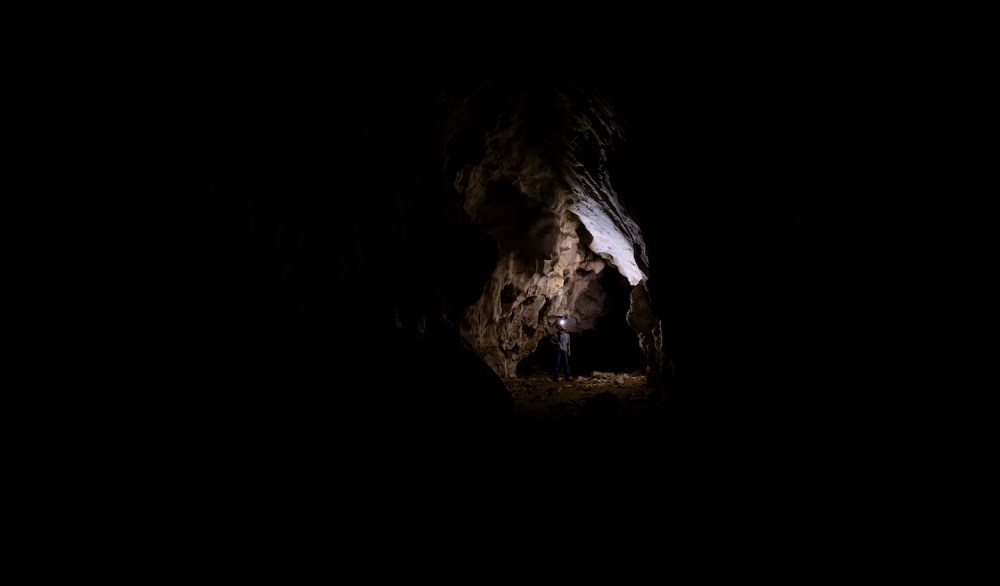
We reached a point where the floor disappeared before us, and we were instead greeted with a pit. An iron ladder, made cold by its time in the darkness, was bolted into the rock to one side. We climbed down maybe twenty feet to the next room.
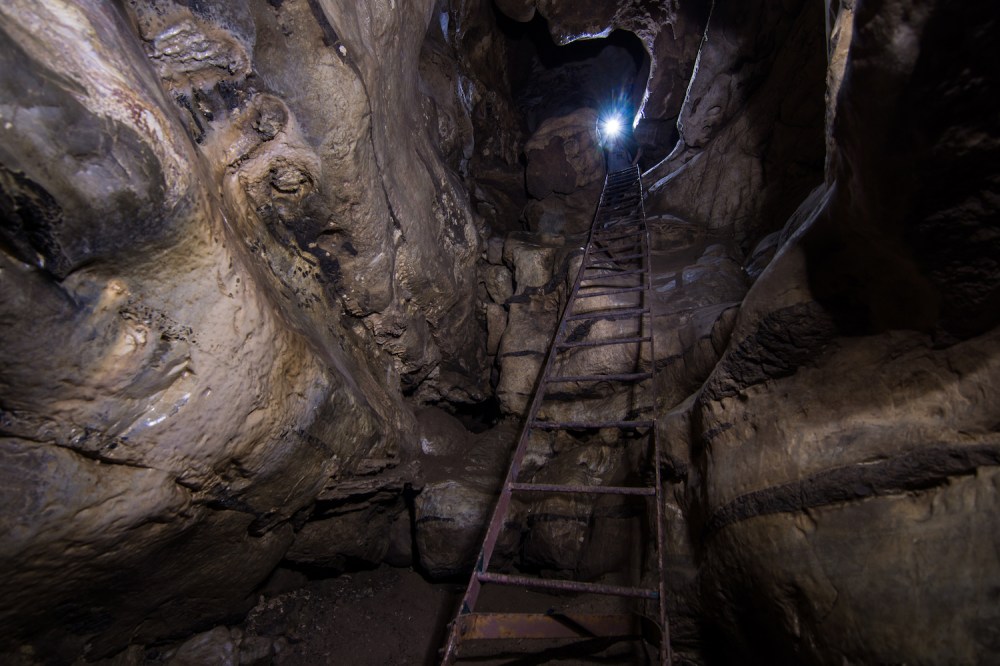
From there the rooms became severely more constricted. We were forced in several areas to army-crawl through the mud and to make awkward acrobatic moves over cloudy puddles. A sort of humming sound replaced the silence here. This went on for a long ways, but finally ended with another pit and another ladder. Heaven knows how anyone was able to get this second ladder down to its resting place, as it also had to stretch twenty feet down to the next level. Nobody had bothered to bolt this ladder into anything, and the only support it had was a small boulder bracing it at the bottom. Despite this, the metal ladder seemed a good alternative to the old ladder: a wood and rope tree-house ladder type deal that hung rotting against the rock behind the metal.


At the bottom of the second ladder, the humming sound we had heard before turned to roaring. A three-part fork faced us, and a quick jaunt down the far-right path revealed to us the source of that roaring. A full, flowing river rushed by at the end of a short passage and off into further darkness. From the little research that Skyler had been able to do on the cave, we knew downstream was one of the unexplored sections of this cave. It wasn’t hard to see why, as the river tunnel narrowed a little ways past us, funneling the water in its already ripping current into something even more treacherous. We would not be exploring there that day.

We returned to the fork, taking the middle passage instead. This route took us down to a large pool of water. On its surface, the pool looked stagnant, but rippling patterns and shadows dancing in it made it apparent that a strong current was pulling at the bottom of the water.
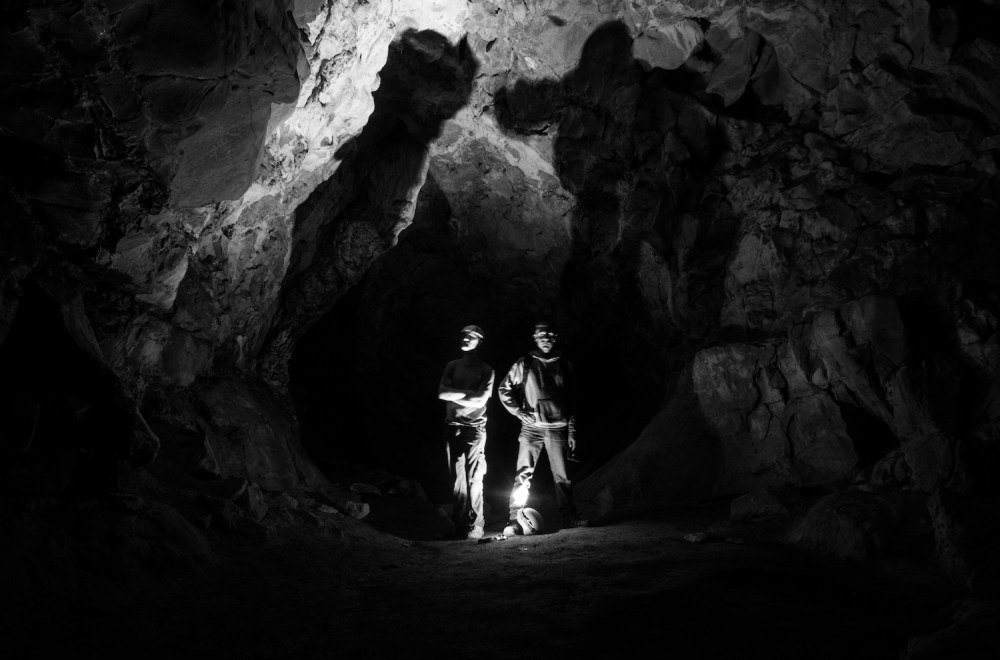
The third, far-left passageway at the fork was the most difficult to access. Some old ropes were tied to a steep rock face, which had to be climbed up. After struggling through a narrow gap though, we were greeted by the largest room we had seen yet in the cave. Our voices echoed off into numerous side passages, and several ancient stalagmite formations stood to one side. On the map at the front of the cave, this room was supposed to be the terminus, but we found that the map was just incomplete as we spent the next two hours exploring side passages.


One main tunnel went onward into a long chasm. This was where we decided to stop and turn back, as we had spent almost six hours underground. We were able to quickly retrace our route out of the cave, no bread crumbs required. Emerging into the warm summer air was almost a disappointment after this adventure.
We met a Forest Service worker as we departed and discussed the cave and surrounding public lands. Because of the limestone, even the valley we were in was supposed to have various unexplored caves still. That seemed like a good proposal for a future trip. But, for the time being, we made our way back to the car, and started the long drive back to Denver.
~Sky & Ty
 The Overcast Adventurers
One thought on “Rite of Spring”